Hummus Is The New Onion Dip

Hummus and pita triangles

Hummus and pita triangles

When I was growing up, it was unheard of to have company over without serving Lipton’s Onion Soup Dip and chips.  At that time I had a complete aversion to onions.  But onion dip was an animal of a different sort. ( Just like onion rings.)  I don’t question this – it’s one of the great mysteries of the world.

More than likely onion dip became popular because not only is it tasty, it’s incredibly easy to make:  mix together 1 cup of sour cream and one packet of Lipton’s Dried Onion Soup Mix. Done.  It took a minute to prepare and you could call it homemade….just.  It was so easy, in fact, that this was the job children (like me) were given when they wanted to ‘help’ mommy in the kitchen.

What was not to like?  Sour cream and onion-y/salty bits.  And was it addictive!!!  Much as I love potato chips, if there was onion dip around, the chips actually became an excuse to load up on dip.

Alas, those carefree, eat-whatever-tastes-good days are gone.  I can’t remember the last time I saw onion dip at a party (not that I get out much). Potato chips and Fritos have been replaced by pita chips and raw veggies, and hummus has replaced Lipton’s Onion Soup Dip. So long, old friend.

Hello, hummus!  And just in time.  The bad thing about getting older is I can no longer eat an entire bowl of onion dip shoveled in via an entire bag of potato chips, and then work it off by doing 10 minutes of jumping jacks. But the good thing about getting older is wisdom. I’m now wise enough to really understand that you are what you eat.

Of course, that being said, let’s not get crazy. I’m certainly not advocating refraining from a bag of french fries once in a while, or the odd dessert when you’ve got that craving going on. (Hey, I’m the one who wrote a recent blog about Thick and Chewy Chocolate Chip Peanut Butter Cookies!) But what I’ve found is that if you make healthy food yummy enough, it kind of talks you off that ledge hovering over the great junk food beyond. When you’re happily sated, you feel….well, complete.

So hurrah that people are now serving hummus and pita chips to snack on at gatherings. Even my extremely picky youngest child is buying hummus for himself – and actually eating it.  This is the same child who throughout his childhood would order a cheese, mustard, and mayonnaise sandwich when we went to Subway.  (And I don’t mean cheese, mustard, and mayonnaise as extras in one of their selections –  I mean ONLY cheese, mustard, and mayonnaise!)

Nowadays, supermarkets – always ready to cash in on trends – are stocking their refrigerated bins with ready-made tubs of hummus, flavored all sorts of ways.  But if you own a food processor (and if you don’t, BUY ONE!), you really should make your own.  At least give it a try!!!  The markup for the ‘convenience’ of not having to make it is enormous. And, as I keeping saying, when you make things yourself you know what’s in your food (and NOT in your food). Along the same line, why stop at making your own hummus – make the tahini, too. Again, it’s unbelievably easy!

This is one of those recipes that you should make to suit your own taste. More garlic, less garlic.  Spice it up, bland it up. Chunky, pureed.  Whatever you want.

NOTE:  Double, triple, quadruple, etc. your homemade hummus, then freeze it for future use.

HUMMUS – makes 1 cup

  • 2½ T tahini – see recipe below
  • ¾ tsp margarita salt
  • 2 cloves garlic, pressed
  • 1 can garbanzo beans (also called chickpeas) – 15 oz can
  • 3 T lemon juice, fresh or bottled
  • 1 T olive oil

Drain the garbanzo beans, discarding the liquid.  Put half the can in the food processor and pulse until the beans are small chunks.  Pour into a small bowl and set aside. Put the remaining garbanzo beans, salt, garlic, lemon juice, and olive oil into the food processor and purée until smooth.  Mix the purée with the chunky garbanzo beans and serve. Sprinkle a little paprika on top to make it pretty, if you like.

TAHINI – makes about ½ cup

  • ¾ cup sesame seeds
  • 2 T olive oil

Lightly toast the sesame seeds.  Put the seeds and olive oil in the food processor and purée. Stop and scrape, as needed, to make a paste.

Egg Foo Yummm!

It isn’t always easy being a vegetarian. Before I changed my carnivorous ways, I had my go-to picks when I went for Chinese food:  won-ton soup, sweet and sour pork, egg rolls, and chicken chow mein.  When I became a vegetarian I found myself carefully examining the menus for meatless choices.  Back in those days I was pretty much limited to stir fried vegetables and rice. This was long before the days when Chinese restaurants started adding tofu – or even removing the meat – from selections on their menus.

I finally spied ‘Egg Foo Yong’ (sometimes spelled ‘yung’ or ‘young’) on the menu and gave it a try.  Mmmmm!  Fortunately, my first sample of egg foo yong was delicious. Since then, I’ve discovered it really depends on the restaurant and the chef.

Egg Foo Yong seemed like a dish I could make at home – I’m always looking for vegetarian recipes AND ways to save money.  Not only can eating out be costly, but I tend to worry if the food preparers are using sanitary precautions.  I admit it – I’m a smidge frugal (okay – I’m cheap) and paranoid.

For those of you who have never heard of Egg Foo Yong, it’s basically an egg pancake with bits of things like mushroom and bean sprouts mixed in, served over sticky rice, and topped with a brown sauce.  I’ll give you the recipe the way I make it, but there’s a lot of room for personalizing. Because these egg patties cook quickly and are best served immediately, I make the brown sauce first, then the sticky rice (and while it’s cooking I get the side dishes going), then I begin the egg pancakes.

The more you can fit on your skillet or griddle the better so the first ones don’t have to sit around too long.  But – word to the wise – don’t crowd them. You’re going to have to flip these babies and, unless you’re a whiz with a spatula, they rarely land where they started. You want to avoid flipping them onto another one.

NOTE:  I use a 13″ All Clad skillet to cook the egg patties and have found that making 3 at a time is the best number.  Perhaps in future, I’ll use my griddle, as well.  That way, I can squeeze in a few more per cooking batch.

NOTE: Cook the rice before cooking the egg patties so it’s ready to go.

BROWN SAUCE – makes 2/3 cup

  • 3g (1½ tsp) cornstarch
  • 4g (1 tsp) sugar
  • 5g (1 tsp) rice vinegar
  • 29g (2½ T) soy sauce
  • 112g (½ cup) water

In a small saucepan put the cornstarch, sugar, vinegar, and soy sauce.  Stir and mash until you have smooth paste (no lumps), then add in the water.

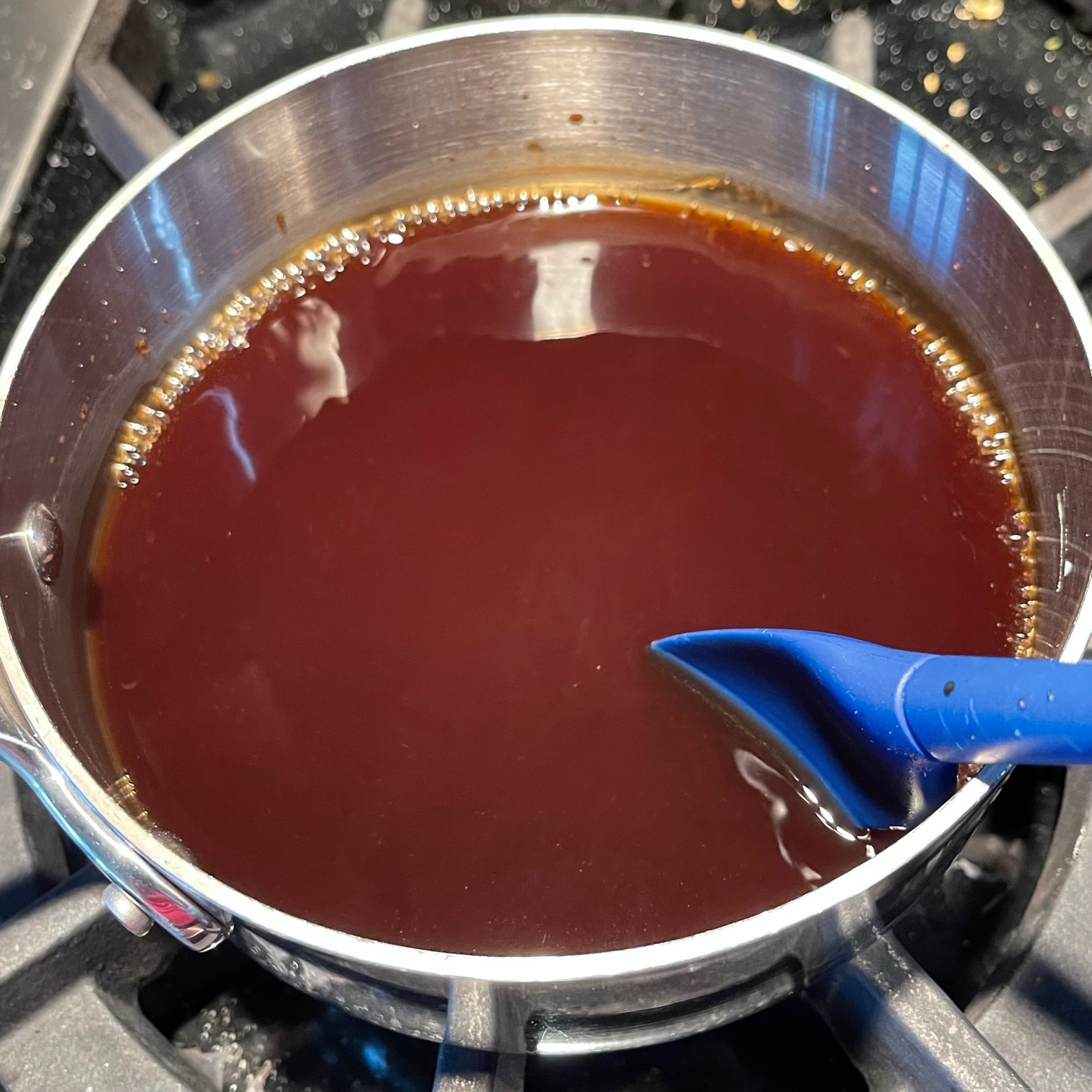
Heat over a medium flame until the color changes from coffee-with-cream color to black coffee color, stirring often. At this point the sauce will thicken a bit.  The color and thickness change will occur just before the boiling point.  Once the sauce begins to boil, turn off the heat.

EGG FOO YONG –  makes 8 patties 4″ in diameter

  • 5 eggs
  • ½ T soy sauce
  • 1/3 cup onions, thinly sliced
  • 4 mushrooms, chopped
  • 4 oz bean sprouts (1 cup)
  • vegetable oil for frying

NOTE:  You don’t have to restrict yourself to onions, mushrooms, and bean sprouts (or even use them at all).  You might try carrots, peas, scallions – whatever you fancy!

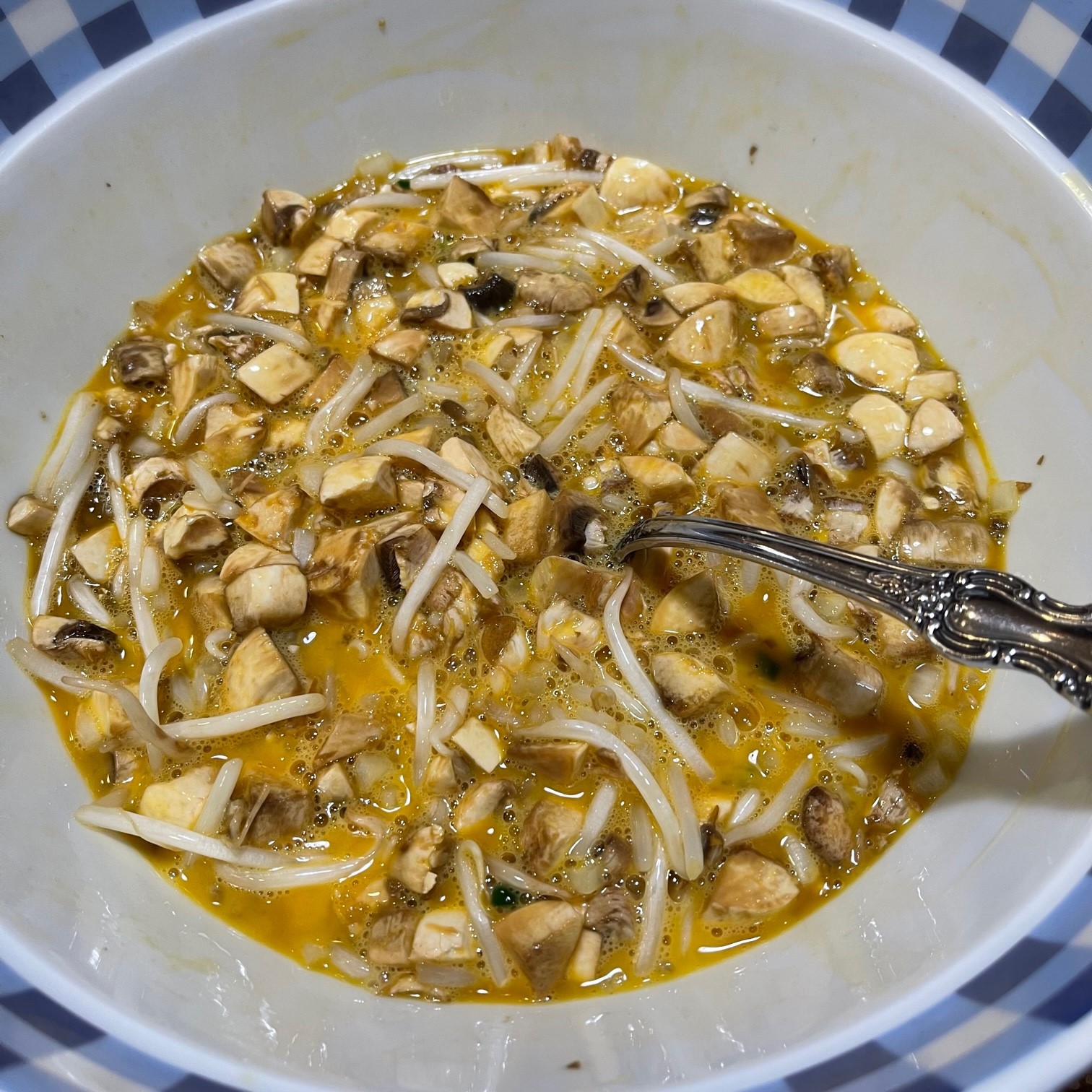
In a medium bowl beat the eggs.  Stir in the soy sauce, bean sprouts, onions and mushrooms.

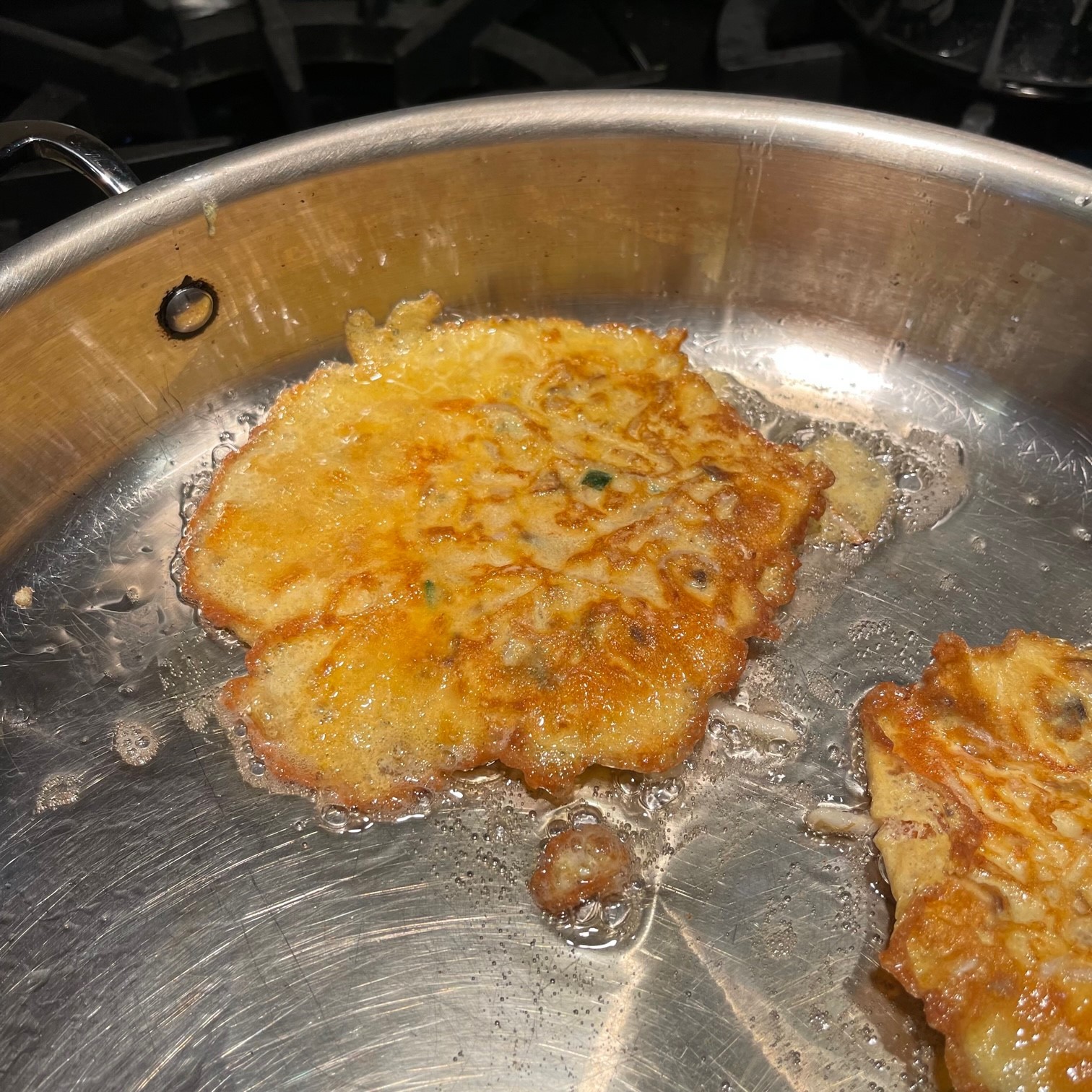
In a large skillet, pour in enough oil to cover the bottom and heat over medium/high.  Ladle on the egg mixture like you were making pancakes.  You don’t want to use too much per patty – maybe 1/3 cup. They spread rapidly and then kind of keep spreading. Try not to have them touch – you don’t want to have to cut them if you can avoid it.  

Flip them when they’re well browned on bottom.  Side 2 cooks very fast.

Once they’re well browned on both sides transfer to a platter.  Add more oil as necessary as you cook the remainder.

Serve them hot over sticky rice, generously pouring the brown sauce on top.

Make A Hot Tomato’s (that’s me!) Stuffed Tomatoes!

Stuffed Tomatoes

Stuffed Tomatoes

I have to confess that until a few months ago I had never eaten a stuffed tomato.  It’s not that I’d never heard of stuffed tomatoes (hey – I’ve been around….well, at least, nearby), it’s just that they never sounded very appealing.  I guess I must have thought they’d be bland and mushy.

For an upcoming dinner party I had planned on making Spinach And Mushrooms Topped Polenta.  This was a mixed group (i.e., vegetarians and carnivores) so I wanted something that appealed to both groups. I always feel like the pressure is on when cooking for carnivores – I want to show them vegetarian cooking is more than tofu and sprouts.

I was racking my brain for the perfect side dish for this entree.  It had to be visually appealing as well as have a taste that complimented the rather bland polenta, spinach, and mushrooms.  Something red, I decided, which pretty much meant carrots, red peppers, or tomatoes.  Tomatoes seemed like a perfect match.  Not only are they a vibrant red, but their flavor would play well against the polenta dish.

In thumbing through several cookbooks (to those of you under 30:  yes, in the old days we used actual books for recipes), I found tomato aspic, soup, stewed, stuffed, and tarts. I honed in on ‘Stuffed’.  Hmmm!  I liked the idea of a contained side dish since the mushrooms were going to be scattered with a brown sauce on top.  A nice, bright, plump tomato would do very well, visually.  Taste-wise, I still had my doubts.

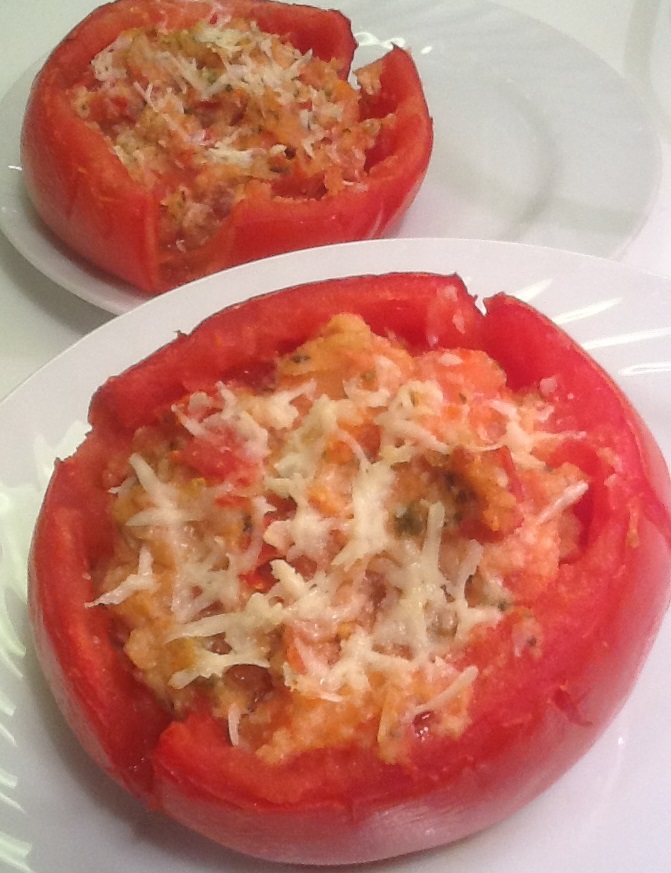
After reading a few stuffed tomato recipes, I came up with own.  Holy Moly!  When I took my first bite, my mouth was aglow with delite.  I actually said, ‘Where has this been all my life?’ I couldn’t believe how powerful the tomato flavor was, balanced perfectly with the garlic, seasoned bread crumbs, spices, and Romano cheese.  Plus these Stuffed Tomatoes formed a perfect marriage with the Spinach And Mushrooms Topped Polenta.

Not only are Stuffed Tomatoes easy to prepare, pretty as a picture, and so tasty you’ll swear you’re hearing angels singing ‘Alleluia’ as you take your first bite, but they can also be prepared (but not baked) ahead of time so that’s one less thing to do as you’re trying to get your meal timed right. (Stay out of my way during the last 20 minutes of dinner prep!)

It doesn’t matter what variety of tomato you choose, but it’s best to use one that’s broader than it is tall.  Tall, thin tomatoes, such as Roma, tend to fall over and spill their contents thus producing an unstuffed Stuffed Tomato.  Not good!  Also, choose ones that are flat on the stem end as this will become the bottom.  For variety, you can also choose a gold or yellow heirloom – what’s life without shaking it up a bit?!

If you’d like to watch me make these delicious Stuffed Tomatoes, click on Stuffed Tomatoes.

STUFFED TOMATOES – makes 2

  • 2 tomatoes (intact and blemish-free)
  • ½ T olive oil
  • 1 garlic clove, pressed
  • 1/4 tsp dried oregano
  • 1/8 tsp dried basil
  • pinch cayenne pepper (also called red pepper spice)
  • 1 small bay leaf or ½ large one
  • ½ tsp salt
  • 2 T seasoned bread crumbs
  • ¼ cup Romano cheese, finely shredded
  • 2 T additional Romano cheese, finely shredded

Slice 1/3″ from BOTTOM of tomatoes.  (The stem end will become the bottom of the Stuffed Tomato). Carefully scoop out and save the pulp, leaving the sides and skin intact. Use a spoon for this task – you don’t want to pierce the sides of the tomato. Clean out all the nooks and crannies of seeds and goo, and give the tomatoes a few good shakes over the sink.  Set aside, letting them drain upside down.

Dice the tomato tops and meatier pulp.

In a small saucepan over a low/medium heat, sautè olive oil, garlic, oregano, basil, cayenne pepper, bay leaf, and salt for 1 minute. Take care not to burn the garlic.  Add in the diced tomatoes, turn up the heat to a medium flame, and cook for about 2 minutes. You want the tomato pieces cooked but not mushy.  What you’ll notice is the pieces have still retained their shape but quite a bit of liquid has been released. Turn off the burner.

Quickly strain the liquid using a small strainer, if you have one, or carefully pouring off as much liquid as you can into the sink (use a lid to prevent solids from slipping through. Empty any solids in the strainer back into the saucepan.  You don’t want to get rid of all of the liquid, just most of it – that’s why you need to do this step quickly.  REMOVE AND DISCARD BAY LEAF!!!

Preheat oven to 350º Fahrenheit.

Stir in the bread crumbs and ¼ cup Romano.  Stuff the tomatoes with the mixture, packing it down.  There should be exactly enough filling for 2 tomatoes.  Top each tomato with 1 T shredded Romano.

Place Stuffed Tomatoes on a greased cookie sheet that has sides (in case of leakage) and bake for 20 minutes. Then turn on broiler (leaving tomatoes where they are) and broil for another 2 minutes, until tops are browned.  Keep an eye on them – you don’t want to burn them! Serve hot.


PEANUT BUTTER/CHOCOLATE CHIP COOKIES: Thick & Chewy!

Thick. Chewy. Chocolate Chip. Peanut Butter. Cookies.  Five words (Yes – I’m counting ‘chocolate chip’ and ‘peanut butter’ as one word apiece!) that individually grab your attention.  But used together, they have the ability to initiate a mighty craving, sending you running for your cookbooks or a local bakery.

I love reading author Joanne Fluke mysteries.  Not only do the characters feel like old friends, but the main character, Hannah,  runs a bakery and Ms Fluke includes many recipes in each book.  One of the recipes in Red Velvet Cupcake Murder, a recent read, was Chocolate Covered Peanut Cookies.  Yummm!  Chocolate covered peanuts are a favorite of mine.  (Who am I kidding – chocolate covered ANYTHING is a favorite!)  Then my mind went a step further and thought that a peanut butter cookie with chocolate chips would be even better – more like a Reeses Cup.

The thing is, most peanut butter cookies are kind of dry, flat, and have those fork marks on top.  I wanted a peanut butter cookie that was thick and chewy – something I could sink my teeth into.  I experimented a bit with both the cookie part and the chocolate chips before coming up with the taste I had in mind.

NOTE:   A walnut sized ball of cookie dough will yield a cookie approximately 1½” in diameter.  If you want a larger cookie, then obviously use more dough.

UPDATE NOTE:  I changed the sugar from granulated to dark brown – EVEN BETTER!!!

CHOCOLATE CHIP PEANUT BUTTER COOKIES – makes 24 cookies 1½” in diameter

  • 56 (¼ cup) butter, soft (but not melted)
  • 123g (½ cup) extra crunchy peanut butter (I used Jif)
  • 127g (¾ cup) dark brown sugar, packed
  • 1 egg
  • 197g (1½ cup) all-purpose flour
  • 1 tsp cream of tartar
  • ½ tsp baking soda
  • ¼ tsp salt
  • 102g (2/3 cup) milk chocolate chips (you can use semi-sweet, if you like, but I didn’t think they worked as well)

Using an electric mixer, beat together the butter, peanut butter, and sugar on medium high speed until fluffy. ( If you’re doing this by hand, your upper arm will get a nice workout.)

Beat in the egg.  

Add in the flour, cream of tartar, baking soda, and salt.  Before turning on the mixer, mix the dry ingredients with the spatula to kind of blend them.  Then turn the mixer on and mix.  Recipes often have you put the dry ingredients in a separate bowl and blend them before adding to the dough.  I would rather not dirty an extra bowl.  My way works fine.  You’re welcome. Pour in the chocolate chips and mix chips in on low.

Preheat oven to 375º Fahrenheit.

For a 2″ finished cookie, roll dough into walnut sized balls and place on an ungreased cookie sheet. Using your fingers, press them to about ½” thick.  These cookies don’t spread much.  

Bake 8-10 minutes – until the edges are starting to brown. Remove them from the oven, letting them set on the cookie sheet for 10 minutes to set.  Then transfer the cookies to a wire rack to complete cooling.

There’s no way I can read one of Joanne Fluke’s Hannah Swensen Mysteries without trying at least one of the her recipes.  My husband’s co-workers are reaping the benefit because when I make her cookie recipes, I send them to work with him…. Well, NEARLY, all of them. Hey, a girl has to eat!


Leftover Easter Eggs? Mom’s ‘Chicken’ Casserole To The Rescue!!!

Unless you’re Cool Hand Luke, you may be reaching your wit’s end trying to use up all those hard boiled eggs from Easter. Well, have I got a recipe for you!  It’s my mom’s famous chicken casserole which I ingeniously call:  Mom’s ‘Chicken’ Casserole. Notice the quote marks around the word ‘chicken’.  That means I use faux (aka – fake, imitation) chicken. This recipe uses 4 hard boiled eggs! And, what the heck – if you’re getting desperate, throw in a couple more.

My mother was a very nervous cook.  She generally stuck to what she knew.  Somewhere along the line she found this fabulous chicken casserole that she made for every occasion. It always drew rave reviews so she figured if it ain’t broke, don’t fix it.  No one ever tired of it.

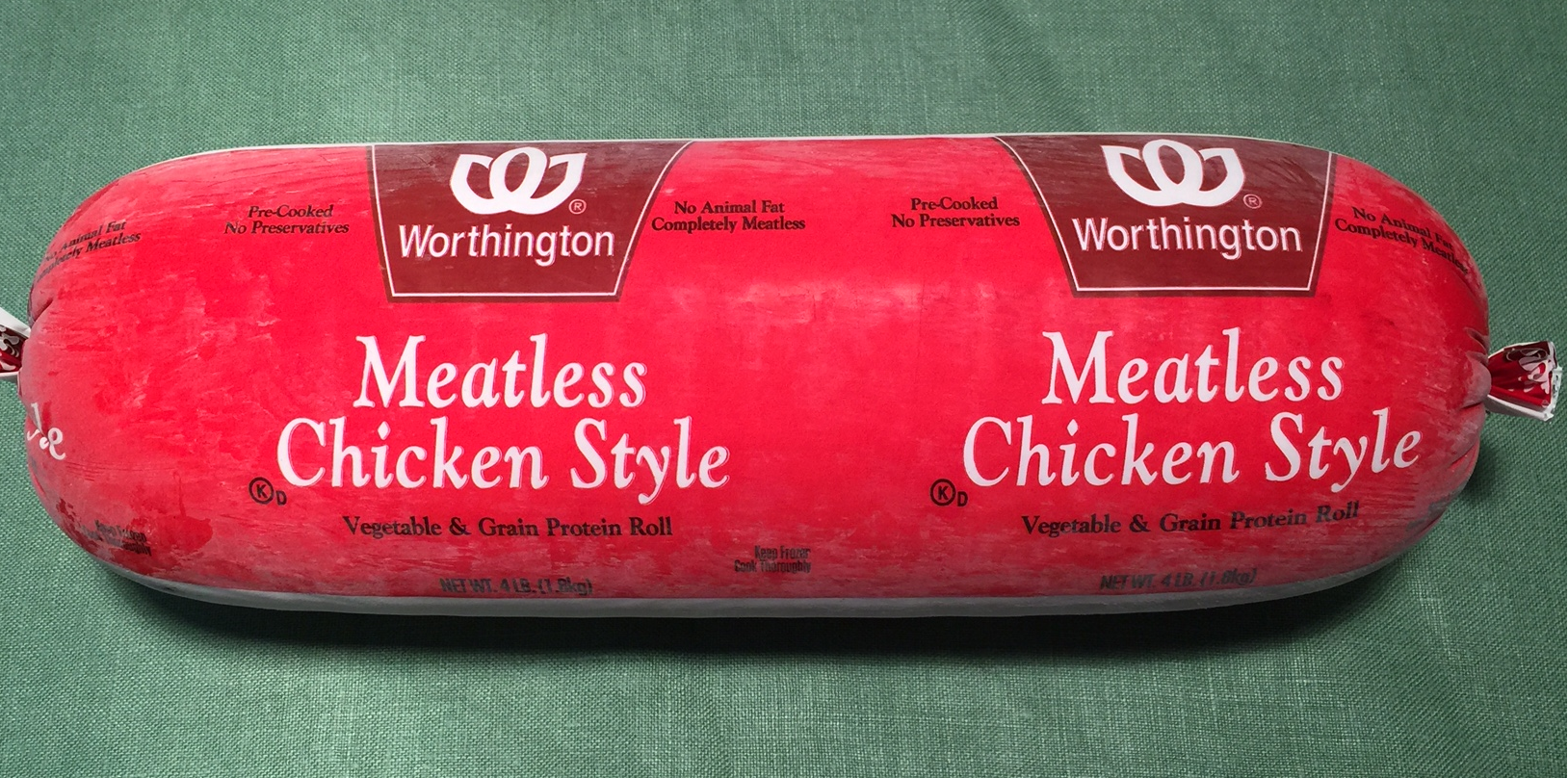
When I became a vegetarian, I figured that was the end of my mother’s casserole for me. But once I discovered there was such a thing as imitation chicken, I (with much anticipation) tried various brands. While some of them were good, they were all too dry for this recipe. Dang! Then I found Worthington’s frozen Meatless Chicken Style roll. What a difference! It’s very moist and gives the illusion that you’re actually eating chicken. So I dug out my chicken casserole recipe and tried the Worthington roll.  It tasted great!  Imitation meats have really expanded my vegetarian cooking repertoire.

A bit of warning (the bad news) – this roll is pricey, so don’t faint when you’re shopping. BUT it weighs 4 lbs (the good news), so you get a lot for your money.  If you were to cut it into cubes, you’d get approximately 14 cups.  And remember, unlike real chicken, the entire roll is edible – there are no bones, skin, fat, and gristle!  Yuck!!!

Here’s my tip:  Since these logs are far too much for any one meal, I let it thaw enough so I can cut it into thirds.  Then I refreeze the portions on a cookie sheet and, when frozen, seal and store them in a freezer bag.  (If you store and seal the portions before they’re refrozen, they’ll stick to each other.)

Mom’s ‘Chicken’ Casserole is one of those great recipes that you can make ahead of time. My mother always made it the day before – she claimed that allowed the flavors to blend. If you do make it ahead, don’t sprinkle on the potato chips (if you decide to use them) or almonds until just before you bake it.  By the way, my mom used the potato chips; I never do.  Of course, it’s delicious with the potato chips (why wouldn’t it be?) but I’m constantly watching my fat and calorie intake so I leave them out.  Either way, the casserole is fabulous!

The original chicken casserole recipe calls for Cream of Chicken Soup.  Of course, since this was now a vegetarian recipe I had to come up with a substitute.  I decided on a thick basic white sauce with some herbs added in.

NOTE:  You don’t have to use Worthington Chicken Style roll.  If you have another brand you prefer, use that.  Taste is subjective.

This recipe is made in the traditional 9½” x 13″ casserole dish.  If you choose to half it (which I did this time), use an 8″ x 8″ pan.  I actually have a cooking video of me making this recipe, if you’re a visual learner.  Click on Mom’s ‘Chicken’ Casserole to watch.

MOM’S ‘CHICKEN’ CASSEROLE

  • 8 cups cubed fake chicken (I used Worthington’s Chicken Style – see photo above)
  • 2 cups celery, diced (about 6 stalks)
  • 1  4-oz jar diced pimento
  • 4 hard boiled eggs, chopped (throw in more, if you like)
  • ¾ cup mayonaise
  • 3 T butter
  • 3 T flour
  • ¾ cup milk (I used organic nonfat)
  • ½ tsp salt (this is separate from the 1 tsp salt that follows)
  • ¼ tsp each of thyme, dill, and celery salt
  • 1 tsp salt
  • 1 tsp dried minced onion (found with the jarred spices & herbs)
  • 2 T lemon juice (fresh or bottled)
  • 1 cup medium cheddar cheese, shredded
  • 2/3 cup slivered almonds, toasted
  • Optional:  1½ cups crushed potato chips

The first thing to do is make a white sauce.  In a small saucepan melt the butter.  Add in the flour and mash it together with the melted butter to form a smooth paste (make sure there are NO lumps – if you don’t do this now, they’ll never come out).  I use a flat-headed wooden stirrer for this.  Once blended, cook the paste over a low flame for 1 minute.  Pour in the milk, increase the heat to medium, and continue to stir until it thickens.  Stir in the ½ tsp salt and the thyme, dill, and celery salt.

In a large mixing bowl mix everything together (including the white sauce) EXCEPT the cheese, almonds, and potato chips (if using).  

Spread evenly into the casserole dish.  If you plan on baking this later, cover with foil and refrigerate.

Preheat oven to 350º F.

To bake, layer the potato chips (if using) on top, then the cheese, and finally the slivered almonds.  Cover with foil and bake for 25 minutes.  Remove foil and bake another 5 minutes.  Serve hot.

I’ll be the first to admit the fake chicken version isn’t quite as good as the real thing. Chicken, Cream of Chicken Soup, and crushed potato chips are all really tasty.  But this is still an excellent casserole!  Remember, the fake meats are geared to talk you off the ledge when you start to weaken. The imitation chicken forms a base to all those other yummy ingredients.

Thanks to imitation meats, vegetarian cooking has come a long way.


Peanut Butter Buns – OR, Two Salts Do Not A Sugar Make

Djash - Peanut Butter Roll

Djash – Peanut Butter Bun

You may or may not be aware, but we Armenians love our food.  I mean we LOVE our food. When I was a kid, family gatherings were centered around the preparing of the feast, the eating of the feast, the cleaning up after the feast, a brief interlude, and then the eating of the leftover feast. Yeah – we like our food.

My dad always loved telling us about how his mother made this fabulous after-school snack called ‘djash’ (pronounced ‘josh’).  It was a rolled bread filled with peanut butter.  With five hungry children in the house, she used to hide it – hoping to dole it out bit by bit.  But hungry children can be very resourceful and they always found it.  This wasn’t a food my grandmother made for holidays – rather it was an everyday kind of thing.  Something to tide her offspring over between the time they came home from school and dinner.

As far as I knew, djash was just another Armenian food that my family ate, along with shish kabab, dolma, madzoon, lahmajoon, etc.  When people familiar with Armenian foods asked which dishes we ate, I would rattle off a variety of foods.  They nodded knowingly until I got to djash – they’d never heard of it.  I didn’t really think twice about that, except even Armenians didn’t know what it was.  My cousin Sue and I were talking about this (she’d experienced the same thing), and she found out why:  ‘djash’ isn’t a specific food – it means ‘lunch’ or ‘little dinner’.  So when my grandmother made djash, she really meant ‘snack’ – it just so happened the snack was a peanut butter bun.  Now I know why I could never find it in any of the tons of Armenian cookbooks I own.

Years ago my dad had me type up (on a real typewriter – that’s how long ago this was) his mother’s djash recipe.  This was years before I learned to cook anything, let alone a yeast bread, so I didn’t see anything amiss with the recipe.  But recently I made djash and, while it was okay, it seemed like it was missing something.  Then I realized it tasted like it needed sugar.  I went back to the original recipe and there it was – the problem.  Salt was listed twice on the ingredients list, in different amounts.  More than likely, I just figured this was a mistake and eliminated one of the salts.  Now that I’m a seasoned cook (I say modestly), I fixed the problem by reinstating the sugar.

If this is your first time making a yeast roll, fear not – I’ll walk you through it.

DJASH (PEANUT BUTTER BUNS) – makes 12 buns

  • ½ T yeast
  • ¾ cup water, approximately 100ºF
  • 3 cups all-purpose flour
  • 8 T butter, cut up and softened (NOTE: more butter is used further down the ingredients list for the filling)
  • 1 egg
  • 1 tsp salt
  • 2 T sugar
  • ½ lb peanut butter (I used the kind you grind in market yourself, made only with peanuts)
  • 2 T butter, softened
  • egg wash (1 egg and 1 T water beaten together)

NOTE:  If you want a sweeter peanut butter filling, you might want to use a brand like Skippy.  The grind-it-yourself kind has no salt, sugar, or oil added.

Stir the yeast into the water and let proof as you prepare the other ingredients.  Into the food processor put the flour, 8 T butter, egg, salt, and sugar.  Pulse several times.  Once the yeast water is proofed (foamy), turn on the food processor and pour in the yeast gradually through the feed tube.  Soon a dough ball will form.  Let the machine knead the dough for 45 seconds.

Smoosh the dough ball into a greased bowl, then flip it so the top is now on bottom.  (That way the ball is completely greased).  Cover and let rise for 1 hour.  In a small bowl, stir together the peanut butter and 2 T butter. Don’t melt the butter – it will make the filling too runny.

Punch down the dough and divide into 12 balls.  One by one, roll each ball to a 4″-5″ circle on a well floured board.  Spread a rounded tablespoonful of peanut butter over the circle to ½” from the edge.

djash roll up bigger

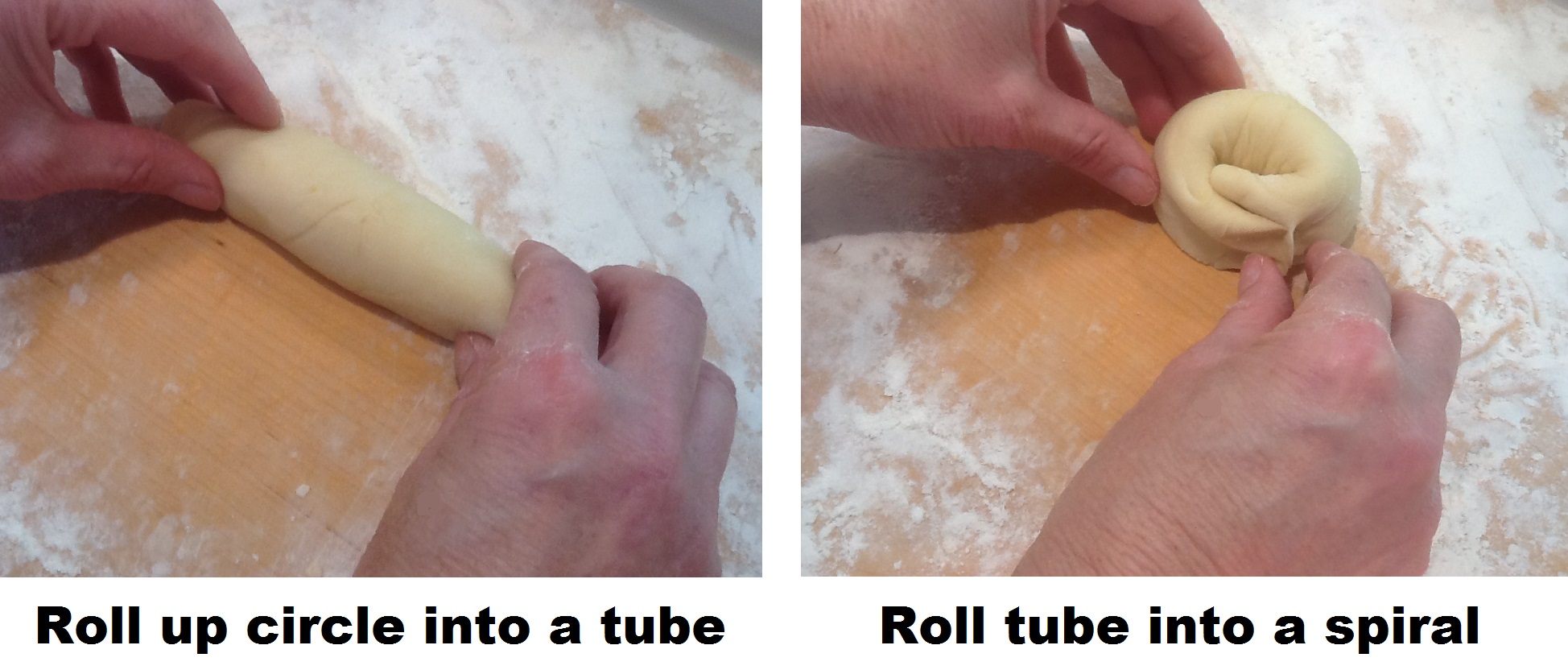
Roll up the circle, like a cigar.  Then roll up this tube sideways into a spiral circle.  Pinch the end into the roll.  After rolling each one, place it on a greased cookie sheet.  Cover them and let rise for ½ an hour.

Preheat oven to 400º F.

Press down each risen roll to ½” thick.  Paint them with the egg wash.  When the oven is heated, place the cookie sheet on the middle rack, then IMMEDIATELY LOWER TEMPERATURE TO 350º F.  Bake for 20 minutes, until lightly golden brown. Remove rolls to a wire rack.  They’re ready to eat hot out of the oven.

One final note from my husband – they would probably taste really good topped with a chocolate frosting.  But, of course, what wouldn’t?!


Back To Basics: Vegetable Stock

Vegetable Stock

While bread may be the staff of life, a good stock is the foundation of a great many vegetarian recipes.  It’s the little black dress of cooking (sorry men – I’m not sure if there’s a male equivalent): every woman should have at least one and you can accessorize it many ways, depending on the occasion.

Yes, it’s true, you can buy vegetable stock in cans and cartons.  In a pinch, that’s a reasonable way to go.  But making your own can save you money (which you should know by now is something I love), AND you can customize it to suit your own taste.  I’ve found the kind you buy are a little heavy handed with the flavor.  Vegetable stock should just add a little flavor to your dish, not overpower it.  Finally, when you make your own, you don’t have to worry about the potential heath concern of BPA in canned foods.

Before going any further, let me point out to those of you who may not know this:  ‘stock’ and ‘broth’ are NOT the same thing.  I used to use those words interchangeably.  Then when I was prepping for my radio cooking show episode on soups, it occurred to me that I should really look those words up so I didn’t give out misinformation.  Low and behold, there was a difference.  A broth takes a stock and goes one step further by seasoning it. Broth would be something you would actually drink, while stock is an ingredient in something such as a soup, casserole, or sauce.

I got this Vegetable Stock recipe from the New Recipes From Moosewood Restaurant cookbook and am quite happy with it as is.  But, of course, you can adjust as you wish.  I ALWAYS double this recipe and freeze it in ½ and 1 cup portions.  By freezing it in the smaller amounts, I can thaw out just what I need.  As you can imagine, I have a LOT of freezer containers.

VEGETABLE STOCK – makes about 8 cups

  • 10 cups water
  • 2 russet potatoes, unpeeled and quartered
  • 2 large carrots, sliced into 2″ pieces (I throw the green stems in, too)
  • 1 large onion, peeled and quartered
  • 1 celery stalk, sliced into 2″ pieces
  • 1 red apple, cored and quartered
  • 12 peppercorns
  • 1 bay leaf

NOTE:  Make sure you wash your vegetables thoroughly – get in all the nooks and crannies!

Put the water into a large stockpot and begin heating it to a boil as you prepare the veggies. Just throw them in as you go.  Once everything is in the pot and it’s at a full boil, cover and lower flame to keep it at a simmer.  Simmer for 1 hour.

I want to stress the importance of this next step so I will use caps:  Strain the stock by pouring it into a colander THAT’S SITTING ON A CONTAINER.  The veggies will stay in the colander while the stock will drain into the container.  You may be wondering why I emphasized this.  I’m embarrassed to admit this, but one time (possibly twice) I was doing ten things at once and when the time came to strain the stock, I put the colander in the sink and emptied my stockpot of Vegetable Stock into it.  I watched in horror as my precious Vegetable Stock rushed down the drain.  I’m sure you must have heard the scream!  Anyone who’s drained a pot of cooked pasta in the sink will probably understand how this happened.

Actually, I found a way to prevent that from ever happening again:  I bought a large stockpot that has a colander insert.  Now I just put the veggies in the colander as it sits in the boiling water.  When it’s done simmering, I lift up the colander and let it sit askew on the pot to drain.

The only problem I have with this recipe is what to do with the cooked veggies.  Currently, I put them in the green waste for composting, but I always wonder if there’s something edible I can do with them.  If anyone has a solution to this dilemma, I’d love to hear your thoughts.


Beer & Cheese Omelette Casserole – Perfect For Brunch, Lunch, Or Dinner!

Beer & Cheese Omelette Casserole

Beer & Cheese Omelette Casserole

Don’t get me wrong – I LOVE Beer Bread.  But you can only eat so much of it before you start wearing it…on your hips.  You know what I’m talking about.  You keep eating something because it’s going to go bad if you don’t.  And, of course, it really tastes better slathered with butter (well, what doesn’t?).

I made Beer Bread the other day (click: Beer Bread – No Need To Knead) and there was still half a loaf left.  I thought about freezing it – I AM the queen of freezing, after all – but wondered if I could use it for dinner somehow.  I perused my recipe cards (for you young folks out there, recipe cards are what we used before the internet).  When I came upon Briggs House 24-Hour Wine And Cheese Omelet I had a ‘hmmm’ moment.  The recipe was an egg casserole with pieces of day-old French bread and white wine, among other ingredients.  I said to myself (and, yes, I talk to myself), ‘How would this taste if I replaced the French bread and wine with beer bread and beer?’  The recipe also called for Swiss cheese.  I wasn’t sure how Swiss cheese would taste with the beer flavor, but I did have jack with jalapeño.  ‘Hmmmm’ (once again – this time with an added ‘m’)….’now that might give it a bit of a kick’.

The final change was made out of necessity.  As the name indicates, you put together the original in advance and then let it rest 24 hours before baking it.  (It’s one of those handy recipes for brunch when you won’t have time to cook.)  It was coming on to the dinner hour so I didn’t have time for it to even take 40 winks, let alone a 24 hour rest.  Once I put it together, into the oven it went.

The final verdict?  It was good.  Very good.  But I have to say, I prefer the French bread and white wine taste.  Maybe next time I’ll split the difference and use beer bread with white wine.  My husband will appreciate that – I had to beg ¼ cup of the beer he was about to drink. The jalapeño jack was great, although so is the Swiss.  The Swiss is more subtle, but the jalapeño really wakes your mouth up.  I guess I’ll just have to see what I have in the fridge next time I make it.

Here’s my version of Briggs House 24-Hour Wine And Cheese Omelet.  Of course, as with most recipes, tweak it to suit yourself.

BEER & CHEESE OMELETTE CASSEROLE

  • ½ loaf beer bread, torn into 1″ cubes
  • 3 T butter, melted
  • 2/3 cup jalapeño jack cheese, shredded
  • 8 eggs
  • ¼ cup beer (I used Hefe.  Use a brand you like since the flavor will come through)
  • 1½ cups milk (I used organic nonfat)
  • ½ T dry mustard
  • ¼ tsp cayenne pepper

Preheat oven to 325ºF.

Butter a casserole dish.  I used a 6″ x 11″ dish which makes a thicker casserole.  But you can use the standard 9½” x 13″ casserole dish if you prefer a thinner omelette (or if that’s all you have).  Spread the beer bread evenly in the dish, then drizzle with the melted butter. Sprinkle on the cheese.

In a medium sized bowl beat the eggs.  In a small bowl put the dry mustard and cayenne pepper. Pour in a little of the beer and, with the back of a spoon,  make a smooth paste. Add this paste, the remainder of the beer, and the milk to the eggs.  Beat until foamy.  Pour evenly into the casserole dish.  Cover with foil and bake for 50 minutes covered, then remove foil and continue to bake another 10 minutes, until the top is browned.  Let rest at least 10 minutes before serving.

NOTE:  Next time I make this, I’m going to add in Morningstar’s Veggie Sausage Patties. They would go really well with this dish – and they’re so good, your carnivores will love it!


Beer Bread – No Need To Knead

BEER BREAD

BEER BREAD

Home made bread is one of those things that everyone loves to eat, but most people shy away from making.  Well, have I got a bread for you:  BEER BREAD!   It’s only got 3 ingredients and – like my extremely clever title promises – no need to knead!

Who doesn’t stop in their tracks when they get a whiff of bread baking in the oven?  This is inevitably followed with an audible ‘aaaahhhhh!’  Add in the aroma of beer and people will be lining up for a slice.

This is a super fast and easy bread to make.  For those of you who like to ‘watch’ recipes rather than read them, you can click on: BEER BREAD and watch my how-to video.  (I like the way my hair turned out in that video, btw!)

One of the odd things about this bread is that even if you don’t like to drink beer, you may still enjoy eating Beer Bread.  When I started making this bread, I couldn’t stand the taste of beer (although, oddly enough, I liked the aroma), but I really liked the bread.  Over the years, I’ve grown to like drinking a pale beer now and again – especially on a hot day.

You’ll notice that the recipe calls for self-rising flour.  Make sure you don’t use anything else.  Otherwise your bread won’t rise.  This is one of those specialty flours I keep on hand, stored in the freezer.  (Did you know freezing flour prevents bugs?  I store all my flours in the freezer.)  As far as I know, the smallest size bag of self-rising flour you can buy is 5 lbs. That’s a lot of flour, especially when all you need is 3 cups.  Just suck it up and buy the bag – you’ll eventually use it up.  Once the self-rising flour is awaiting use in the freezer, you can make Beer Bread at the spur of the moment (as long as you have beer on hand….which is a given in my house).  It only takes a few minutes to get it into the oven.

BEER BREAD

  • 3 cups (453g)  self-rising flour
  • 3 T (30g) sugar
  • 1 bottle beer, room temperature and sealed

Preheat oven to 375ºF.

With a spoon, mix the flour and sugar together in a bowl.  Open the beer and pour into the flour all at once.  Immediately begin incorporating the beer into the flour with the spoon. Pour the batter into a greased loaf pan.  Bake for 45 minutes – until golden brown on top.

Take the loaf from oven and let sit a few minutes. Then run a knife around the sides and remove the Beer Bread to a wire rack to cool.

A word of caution:  tempting as it may be to slice into the hot loaf – restrain yourself! Cutting into a hot loaf of bread causes it to fall apart.  And ladies, keep your husband away from it – the aroma of hot bread combined with beer draws them like a magnet.

Homemade Yogurt – The Easy Way!!!

Yummy Homemade Yogurt

Yummy Homemade Yogurt

After my last post – Roasted Carrots – Shaking It Up A Little – I felt the need to redeem myself in your eyes – to prove to you I AM a frugal (cheap) and careful (paranoid – as in wondering, ‘Whose disease ridden hands have been touching my food?!’) cook. In that post I confessed to using bagged, ready-to-go carrots.  I’m planning on buying unbagged carrots next time I shop….unless, of course, the bagged are on sale – in which case all bets are off. Cheap trumps paranoid every time.

So, how about this:  I make my own yogurt!  And I don’t mean I buy the plain, then add in fruit. I actually grow my own. People are often astounded when I tell them that.  In truth, it’s the easiest thing in the world – once you learn the secret:  make it in a thermos.  Crazy? Crazy like a fox!

I remember my dad making yogurt, although we called it by the Armenian name – madzoon. I can still see him opening the oven door and removing a stockpot full of fresh yogurt.  We used to eat it with crushed strawberries. It was so good.  And healthy!  I firmly believe that’s why Armenians live to such a ripe old age even though they are often a smidge overweight (I’m trying to be tactful.  Holiday dinners were always in 2 parts:  Part 1 – the freshly made dinner.  Part 2 – everyone had recovered from Part 1, reheated the food, and eaten again.)

When I left home, I bought the container yogurts because that’s what everyone did.  You know those container brands:  you turned them over and the yogurt plopped out but kept the container shape.  My dad’s yogurt never did that.  Then I found Yoplait and it was more like the real thing.  But, it was expensive. Finally, I decided to make my own and save money (me?).  I found a recipe, mixed up my yogurt, and then put it in the oven to grow, the way my dad did.  Nothing happened.  I threw that batch out and tried again.  Again – nothing happened. I wondered if it was my oven – too hot?  not hot enough?  I gave up – I was throwing money down the drain, rather than saving it.

Then one day I was thumbing through a giant how-to book I’d borrowed from the library.  (I love how-to books!) And there it was:  make yogurt in a thermos. Now THAT sounded interesting. I tried it and – hurrah! – it worked.  When I thought it through, I realized that a thermos was the PERFECT venue to grow yogurt.  As Mr. Spock would say, ‘It’s only logical.’ In order for the yogurt culture to grow, you need a constant temperature and it needs to be left alone (like Greta Garbo). What could be better than a thermos?

I used to make my yogurt in a 32 oz mirrored-interior Aladdin thermos.  It worked great.  If you’d like to see my video for making yogurt, go to:  Yogurt Made In A Thermos.  Since then, however, I’ve bought a larger and wider mouthed thermos:  a 68 oz stainless steel Thermos Brand thermos that I got on Amazon.  (My family goes through a lot of yogurt.) With the wider mouth, it’s so much easier to remove the yogurt. Bonus!  And, for some reason, the yogurt is coming out creamier. Double Bonus! Finally, the interior will never shatter if you accidentally knock it over – (yeah- I’ve done that twice).  Triple Bonus!

Yogurt offers lots of health benefits: it has calcium (good for bones), bacteria (good for the gut), helps boost the immune system, and may reduce blood pressure – to name a few. Google ‘yogurt’ and read about it. It’s amazing!  I eat yogurt nearly everyday.  In fact, my brother lost 20 pounds and the only thing different in his life was he started eating yogurt every morning.  Maybe not scientific proof… but anecdotal.  And it couldn’t hurt.

Besides saving tons of money by making it yourself,  homemade yogurt has no additives or preservatives or thickeners or added sugars.  Take a look at the ingredients list on the side of a carton of store-bought yogurt – almost without exception, there will be things on that list that you’d be better off without.  All that should be in yogurt is milk and a bit of culture from your last batch.  (I’ve heard you can freeze that starter culture until you’re ready to use it – but I’ve never tried it.)

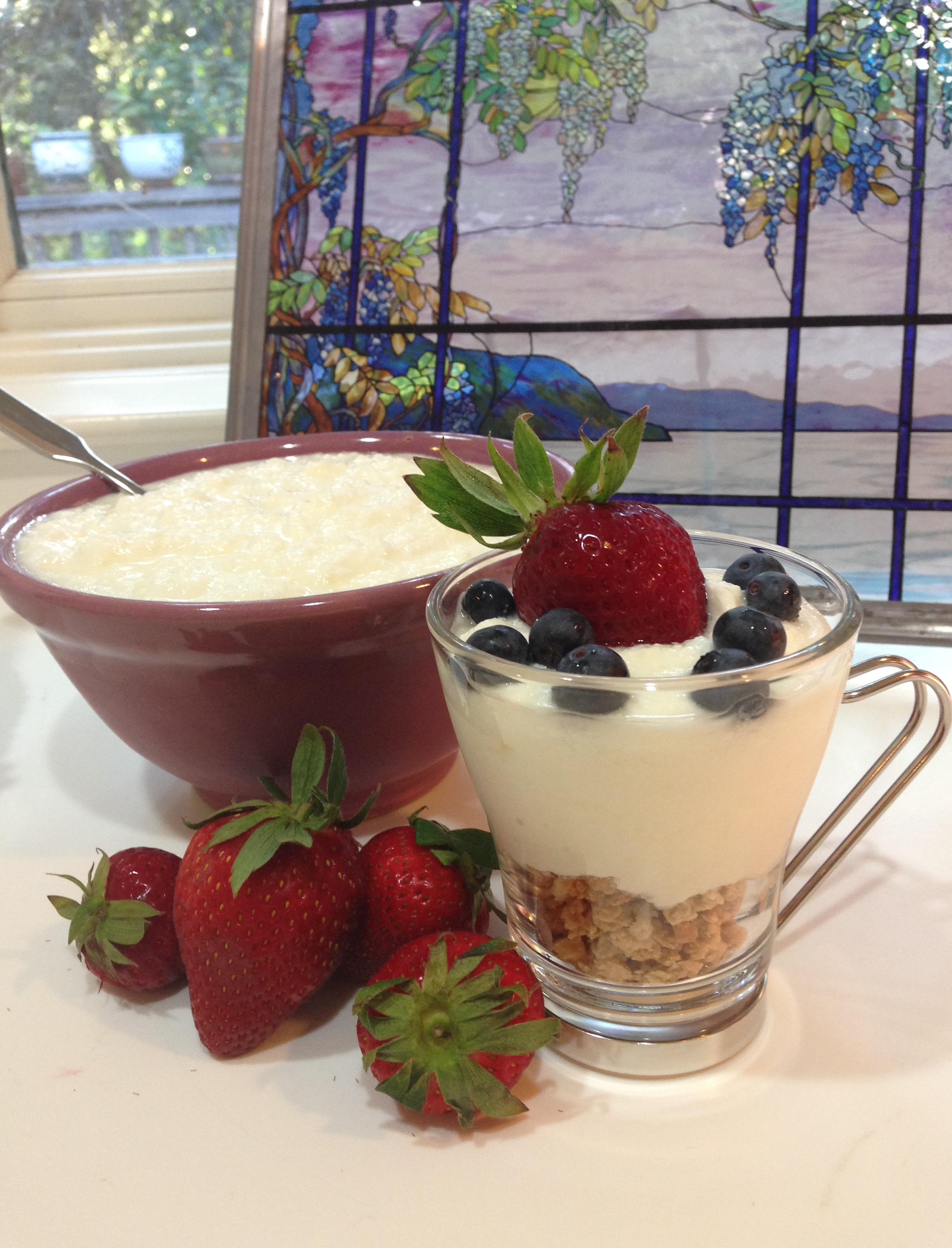
NOTE:  If you’ve never eaten homemade yogurt, it might take some getting used to. Commercial yogurt has sugar to sweeten it up.  The real thing is pretty tart.  Since I grew up eating it, it doesn’t bother me at all.  But you may need to add fruit (which is a great way to fulfill that pesky daily fruit requirement) and/or granola.  Just make sure you don’t add anything to the whole batch before setting aside enough to start your next batch.

YOGURT IN A THERMOS – makes 32 oz of yogurt (recipe can be doubled – use a bigger themos)

  • 3¾ cups milk (I use organic nonfat)
  • ¼ cup PLAIN yogurt (if you don’t have some from your last batch, buy plain yogurt)
  • Optional:  1 cup powdered milk (I use this to thicken up my yogurt since I used nonfat milk)

Over a medium-low flame, heat the milk and powdered milk (if using) to 180º F – stirring often. Remove from heat and let cool to 112º F.  While it’s cooling, prime your thermos by filling it with hot water – by doing this the warm milk won’t lose heat when it’s poured in. When the milk has reached 112ºF, gently stir in the yogurt starter.  Empty the water from the thermos and pour in the milk mixture.  I STRONGLY suggest you use a funnel when pouring so you get the milk IN the thermos instead of ON your counter.  (I learned THAT the hard way!) Then, set the filled thermos aside where it won’t be disturbed.

The yogurt needs 8-12 hours to grow – the longer it grows, the tarter it gets.  There’s no right or wrong – it’s all a matter of preference.  I like mine to grow 12 hours or a little less. When time is up, empty the yogurt out of the thermos and into a container.  Store in the fridge.  If your thermos has a narrow mouth, you’re going to need to be a little creative because the yogurt won’t pour out.  I’ve taped a narrow spatula to a long wooden spoon and, also, used the stick end of a really long wooden spoon.

For those of you Greek yogurt fans out there, all you have to do is drain the whey from your homemade yogurt.  Let the newly made yogurt cool in the fridge first, then line a large sieve or colander with a tea towel or coffee liners and pour in the yogurt.  Make sure you have a container to catch the whey – it starts dripping out immediately.  And save the whey for future use (google it) – it can be frozen.  You know me – I hate waste!

NOTE:  Make sure you have a thermometer that registers as low as 112º F.  I used to use a glass candy thermometer, but after breaking two of them, I finally bought a metal digital.  I love it!!!

You may have already worked out the math, but if you haven’t, let me warn you:  DON’T START MAKING YOUR YOGURT AT A TIME WHEN THE YOGURT WILL BE DONE WHEN YOU’RE ASLEEP OR NOT HOME!  It takes about an hour to heat and cool the milk, then the growing time is 8-12 hours.  So add up the hours before starting.  Yogurt doesn’t shut off when it’s done – you have to remove it from the thermos and cool it in the refrigerator to stop the process.