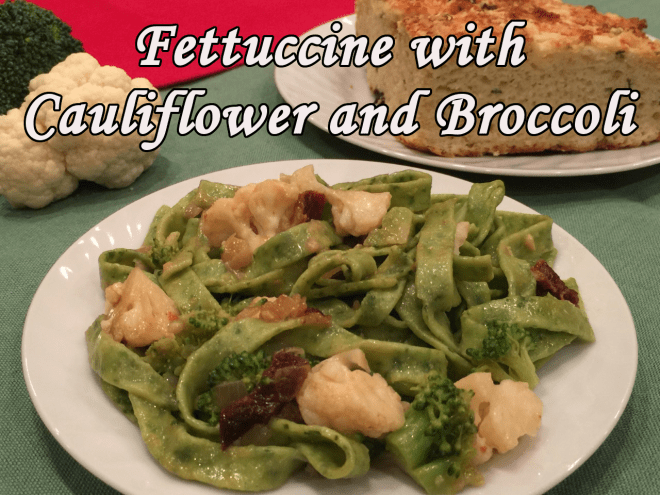
 I’m always looking for quick and easy recipes that are low in calories. I found Spinach Fettuccine with Cauliflower & Broccoli in Green’s Cookbook, and it filled the bill. Of course, I had to tweak it a bit, as you probably will, too.
I’m a bit of a compulsive DIY-er, so I make my own pasta. (I’ve included my recipe for spinach fettuccine at the end, for you brave souls.) You can shave off some time by purchasing the fettuccine. By the way, you don’t have to use fettuccine – choose a different pasta if your prefer (or don’t have any in the house).
FETTUCCINE WITH CAULIFLOWER & BROCCOLI – makes 2 large servings
- 4 T butter
- 3 shallots, finely chopped
- 2 garlic cloves, pressed
- 2 tsp balsamic vinegar
- 2 T Dijon mustard
- 1 T sun dried tomatoes packed in oil, chopped
- 1 T salt
- 3 cups total broccoli and cauliflower, chopped in bite-sized pieces
- 1/2 pound fettuccine (or any pasta you prefer) Recipe for Spinach Fettuccine follows at end.
- 1 tsp lemon zest
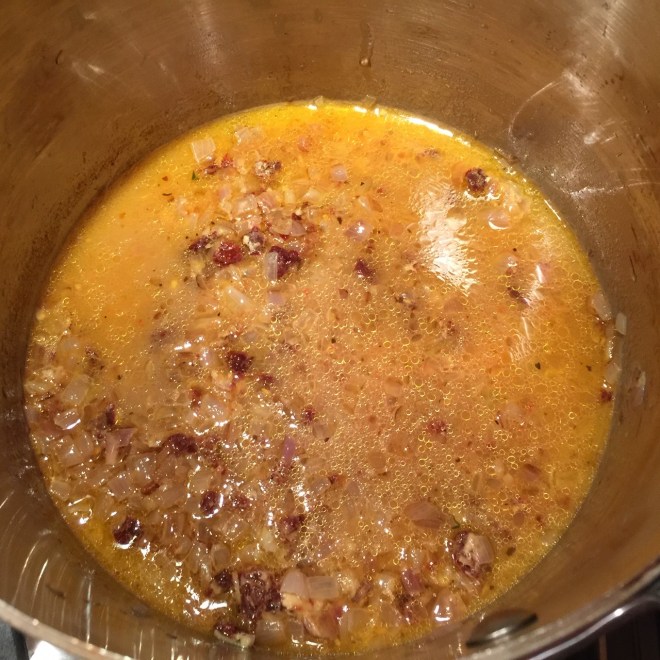
Melt butter in 3 or 4 quart saucepan. Add shallots and sauté for 3 minutes over medium flame. Add in garlic and cook another 30 seconds.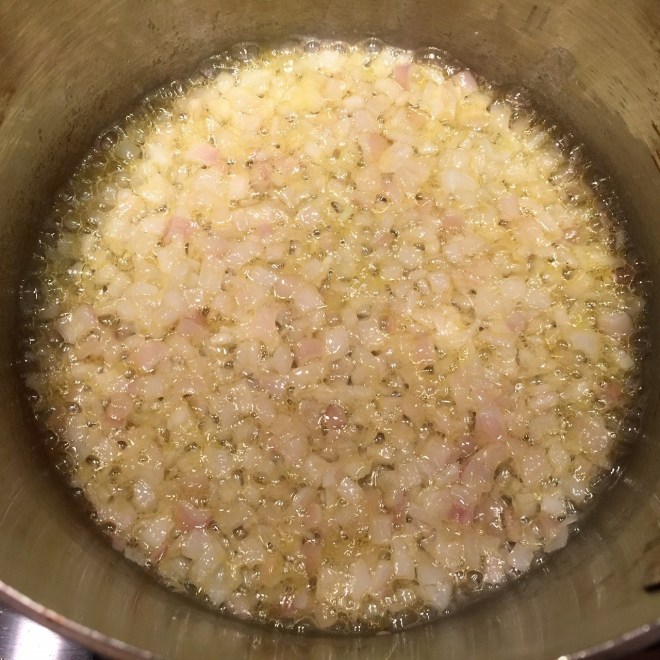 Remove from heat and stir in vinegar, mustard, and dried tomatoes.
  In a Dutch oven, bring 2 quarts of water and 1 T salt to a boil. Remove 1/2 cup of this water and stir into shallot mixture.
  To the pot of boiling water add the broccoli and cauliflower.
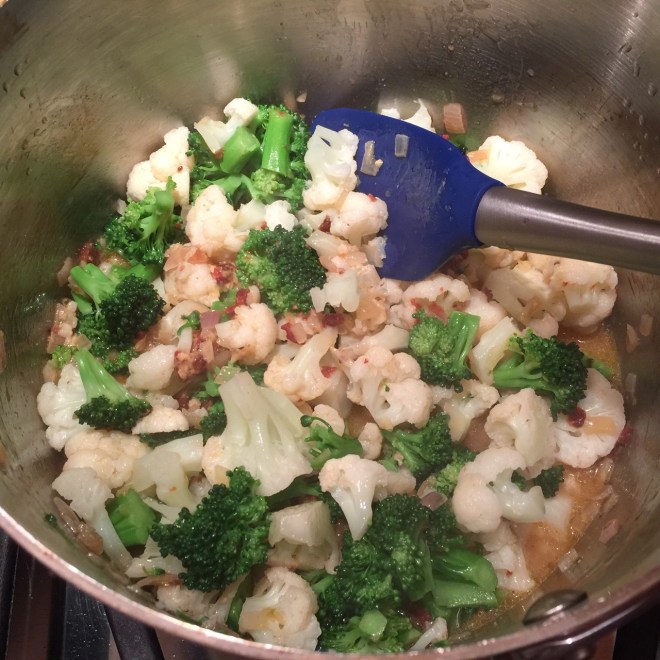
  When the water resumes boiling, cook veggies 1 minute only, just to blanch them, then scoop them out and add to the shallot mixture (which is still off-heat).
 Add the pasta and lemon zest to the boiling water, cooking until the pasta is done.
 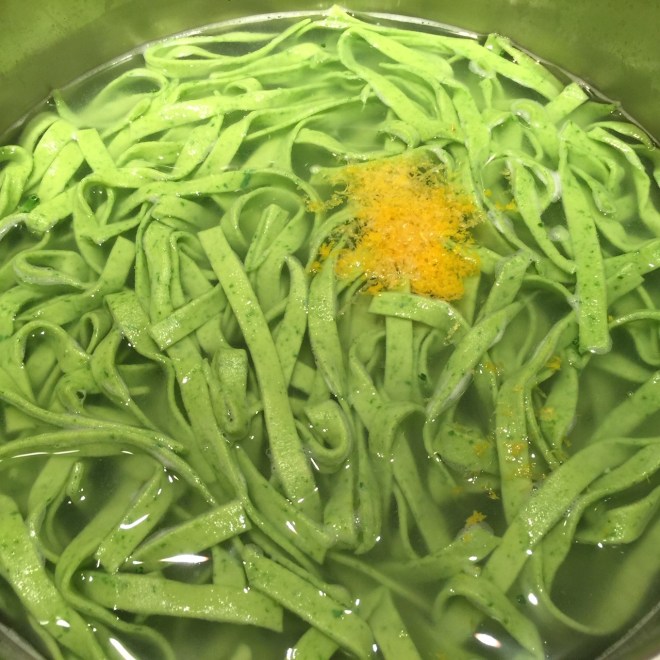 Save a cup of the pasta water in case you need it, then drain pasta. Into the empty Dutch oven combine the shallot mixture and pasta.
 Adjust seasoning, if needed. Add saved pasta water if you feel it needs to be looser.
SPINACH FETTUCCINE – makes 2 servings
- 1 cup fresh spinach leaves
- 1 egg
- 1 tsp olive oil
- 1 cup + extra all-purpose flour
Note: For this recipe you’ll need a food processor and a pasta machine (I use the Atlas hand cranked brand)
Remove and discard stem ends from spinach leaves.  Chop leaves with knife, then place in food processor and pulse until leaves are very finely chopped.
  Add egg and oil, and pulse a few times to blend.
  Pasta making is all about having the right ratio of liquid to dry ingredients. The spinach, egg, and oil are the wet, and the flour is the dry. You’ll have to go by feel since the water in the spinach and the size of the egg are variable. Don’t worry, there’s wiggle room!
Add in 1 cup of flour and run machine about 10 seconds, until mixture is blended. It will probably be too dry. Try to form a ball with some of the mixture. If it crumbles, you’ll need to add some water, 1 tsp at a time. If it feels like Playdough (i.e., it holds together and feels kind of tacky), it’s done. If it forms a ball but sticks to your fingers, it’s too wet – add more flour, a tablespoon at a time. When dough reaches the proper consistency, form 2 balls and place them back in food processor with lid to rest for about 1/2 hour or so.
  Attach pasta machine to a table or countertop with plenty of room to lay out dough. You’ll also need something to hang the dry pasta over, such as a dowel. Pour about 1/4 cup of flour on the work surface. Work as quickly as you can so the dough doesn’t dry out.
Take one dough ball and smash it into the flour. Flip dough and smash other side into the flour. Brush off extra flour the run dough through machine at the lowest number setting (this will be either ‘0’ or ‘1’). Fold dough like an envelope and run it through again.
 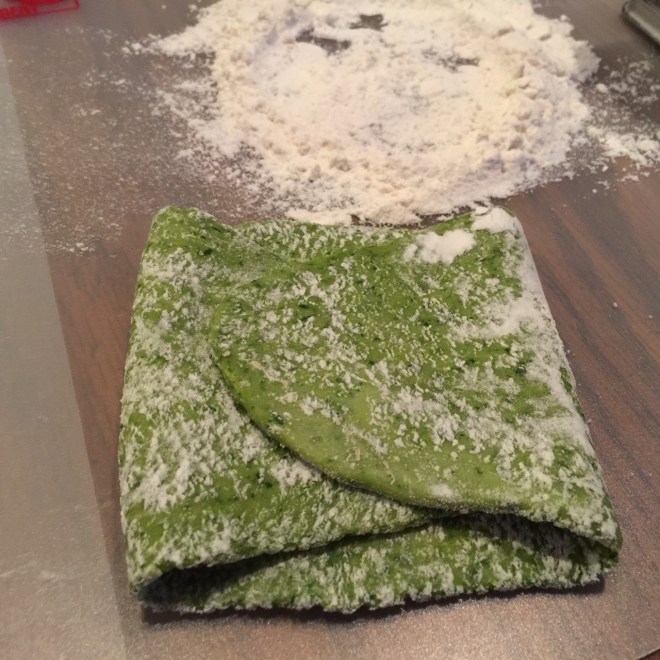 Lay dough flat and rub a little flour over both sides of dough.
  Fold in half and run it through machine at same setting. Repeat this last step 3 more times. You will have run the dough 6 times through the machine on the lowest setting. Repeat with second dough ball.
TIP: Each time you run the dough through the machine, say the number you’re on aloud so you don’t forget what number you’re on. It’s better to do too many than not enough – by the 6th run-through you’ll see a big difference in the dough consistency.
Turn the machine number up 1 digit and run each dough strip (without folding it) through 1 time only. Rub the dough (like before) with a little flour. Increase the number, run the strips through (again, without folding). You’ll notice the strips get longer with each number increase. It’s a personal preference as to how thin you want your pasta – I like to stop after number 5.
When you’re making your final pass with a strip, cut it to the length you want your pasta – I usually cut it in thirds. 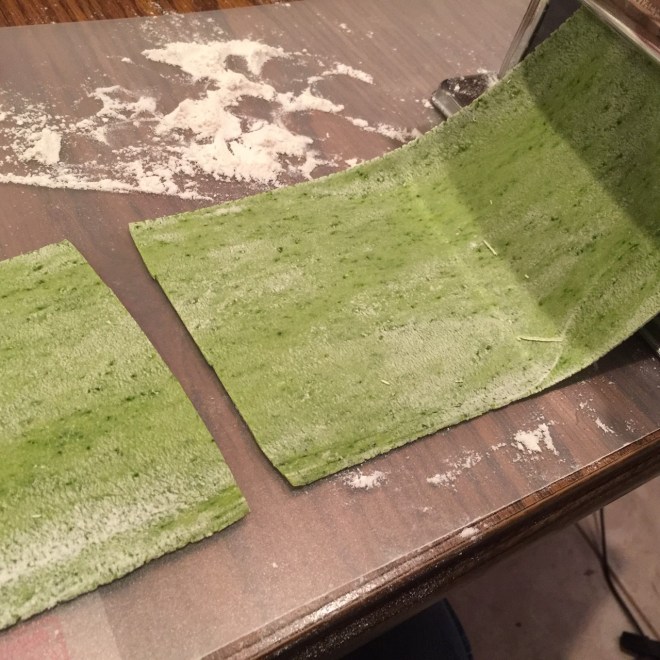 Run these pieces through the cutter before doing the other strip, so the cut edges don’t dry out.
Hang cut dough until ready to boil.
 Who doesn’t love a warm loaf of Italian bread? Well, now you can make one just as good as any bakery….for pennies!
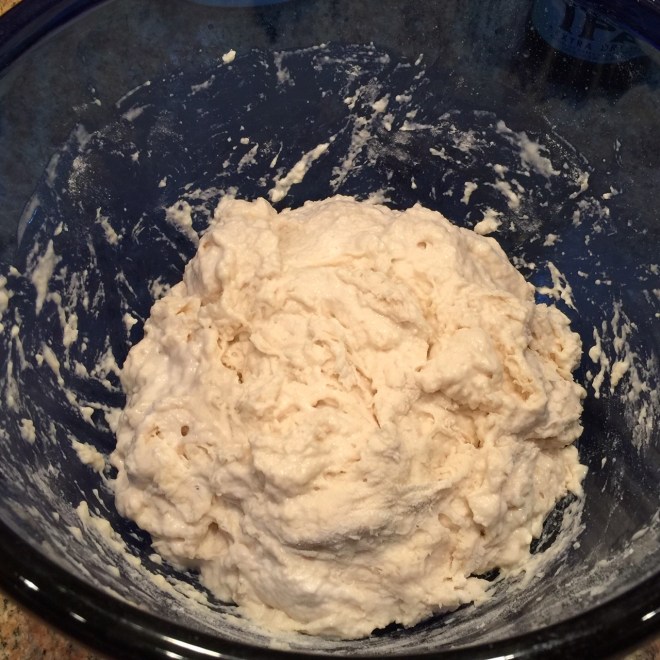 Cover bowl with a plate or tea towel and let the dough rest on the counter 18 – 24 hours (the longer, the better flavor). You’ll notice a significant change to the dough – it will become wetter and bubbly: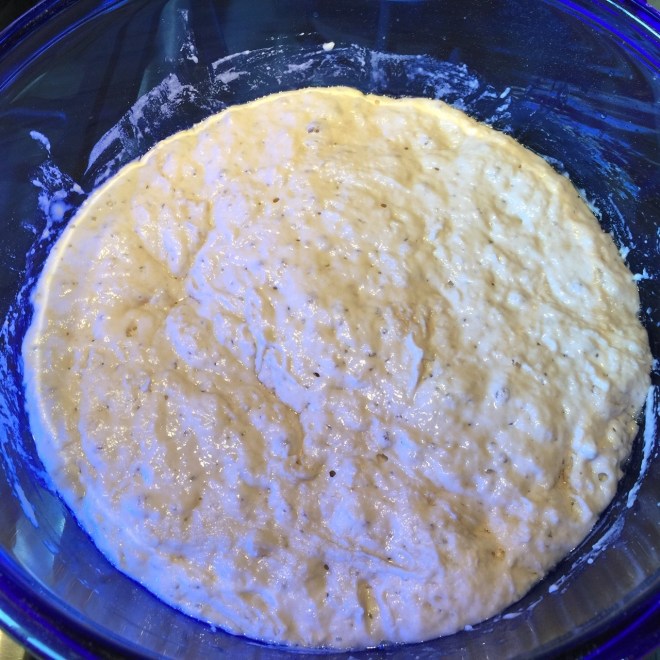
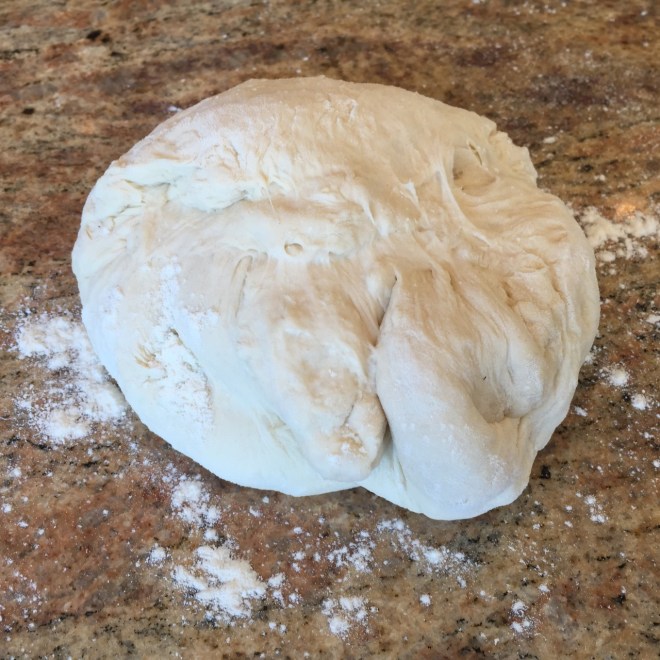 Cut a piece of parchment paper big enough to line a 3-4 quart saucepan with corner ‘ears’ sticking up. Rub paper with a light coating of vegetable oil and lightly sprinkle bottom with flour. Place dough in center of paper then lift the dough into the saucepan by the 4 corners of the parchment. Cover with lid and let rise on the counter for 4 hours.
 Cover with lid and place in cold oven. Immediately turn oven on to 450°F. (As the oven slowly heats, the dough will yield more oven rise.) Set timer for 1/2 hour.
  After 1/2 an hour, remove lid and continue baking without the lid until the temperature of the interior of the loaf reaches 209°F.
 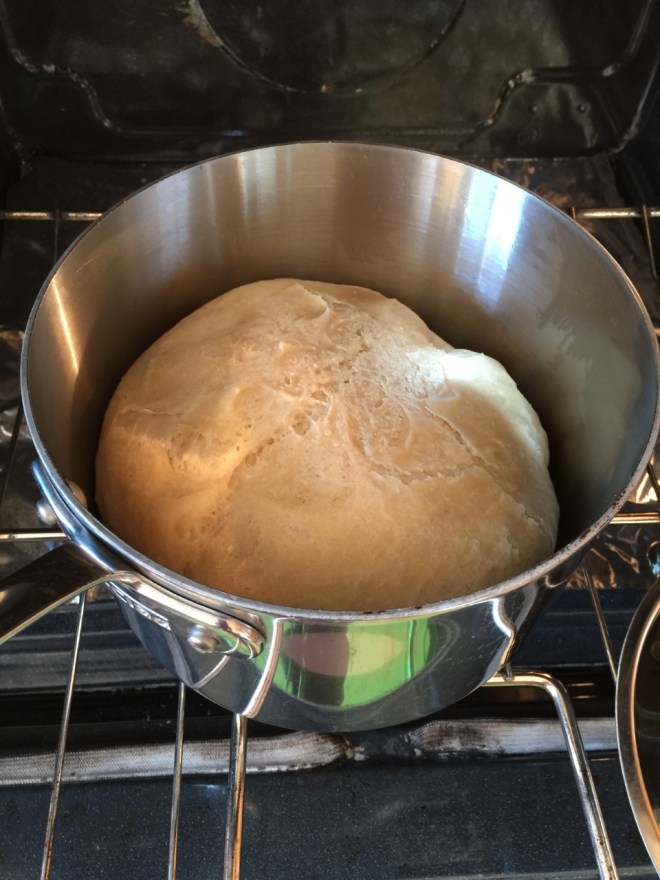 If you don’t have a thermometer, do a visual check – the top should be well browned. Remove the loaf and the bottom should be browned, too.
  Remove loaf from pan to a wire rack to cool. Let loaf cool at least 20 minutes (this takes some will-power) before slicing in order to get a cleaner slice.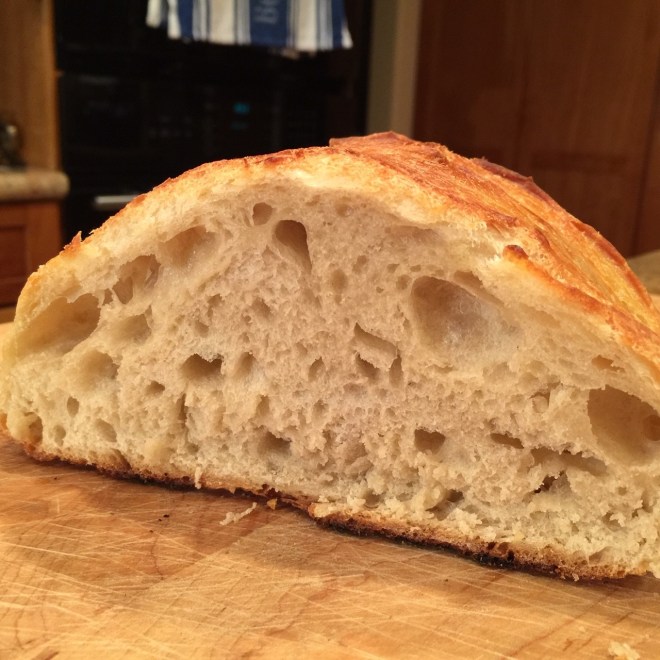
 Mexican Rice is one of those foods that can be both a side dish and an ingredient in something else. For example, Monday night you might want a side dish with a bit of a kick to perk up a main course, and then on Tuesday it can become part of a burrito or taco. One preparation, two meals! Love it!!!
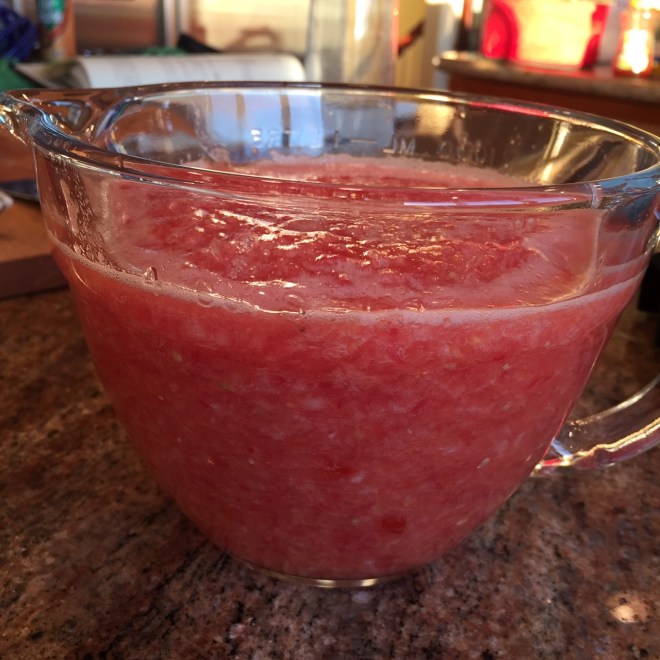
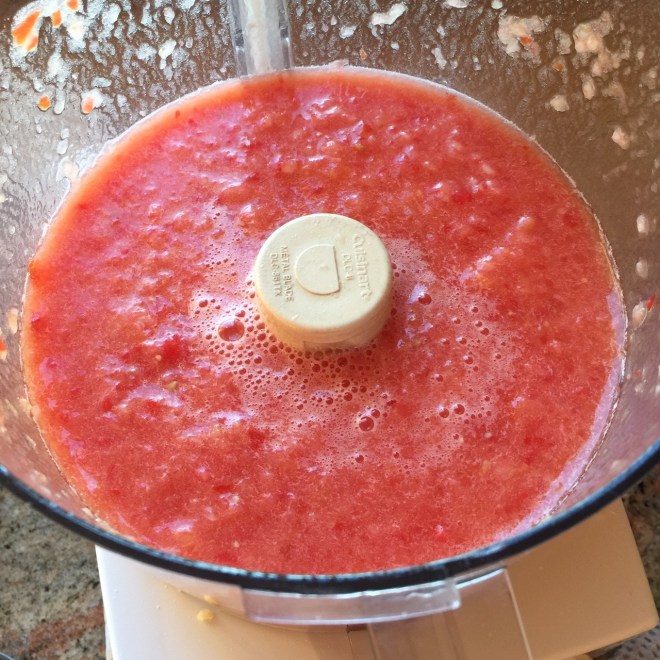 Empty into a large measuring cup and add enough stock or water (both work fine) to add up to 4 cups total. Set aside.
 Put uncooked rice in a sieve and rinse well to remove excess starch.
  In a saucepan, heat oil. Add rinsed rice and sauté 6 minutes.
  Stir in the tomato purée, garlic, salt, jalapeños, and tomato paste. Pour into casserole dish.
  Cover and bake at 350º F 30-40 minutes, stirring halfway through, until rice is fully cooked. (Make sure rice is fully cooked – it won’t continue to soften off-heat.)
  Add in cilantro and lime juice to taste. If you want more kick, stir in another minced jalapeño.
 There is a reason people say, “easy as pie”. Making a pie IS easy. Of course, making a great pie is as easy as making a bad one, so it’s important to have a great recipe.
 Working quickly, peel and core the apples. Cut 3 of the apples into 1/8″ thick slices, and the other 3 a little thicker. Make sure they’re bite-sized for ease of eating – you don’t want long strips of apple.
  Add apples into the flour mixture and blend well.
  Pour into the cooled pie crust – there’s a lot of filling, so you’ll have to pile it high towards the middle. Make sure none of the apple pieces sit on the crust edge.
 To prevent over-browning, cover the pie edge with foil or purchased pie edge protectors (see photo of what I use).
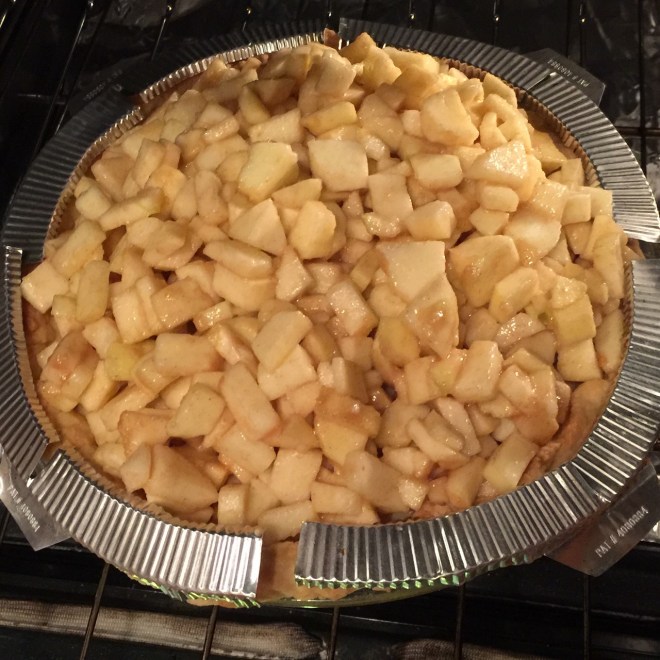 Bake at 375º for 25 minutes.
 When the pie has cooked for 25 minutes, remove from oven. Evenly sprinkle on streusel and remove the edge protectors. Return pie to 375º F oven and bake another 20-25 minutes. Don’t let the top get too brown or it will make slicing difficult to cut through.
 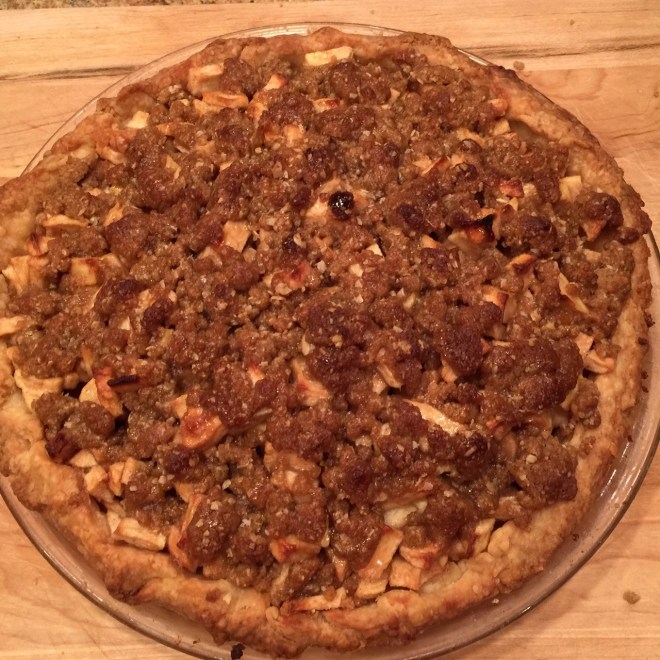 Place pie on a rack or stovetop and drizzle on the caramel topping. Let set at least 1 hour, preferably longer, or you’ll have a lava flow when you slice it.
 Apple season is upon us. While there are a plethora of pie, tart, and bread recipes made from these red beauties, I decided to try something a little different: APPLE-SWEET POTATO HASH. The combination of apples, sweet potatoes, and onions works surprisingly well.
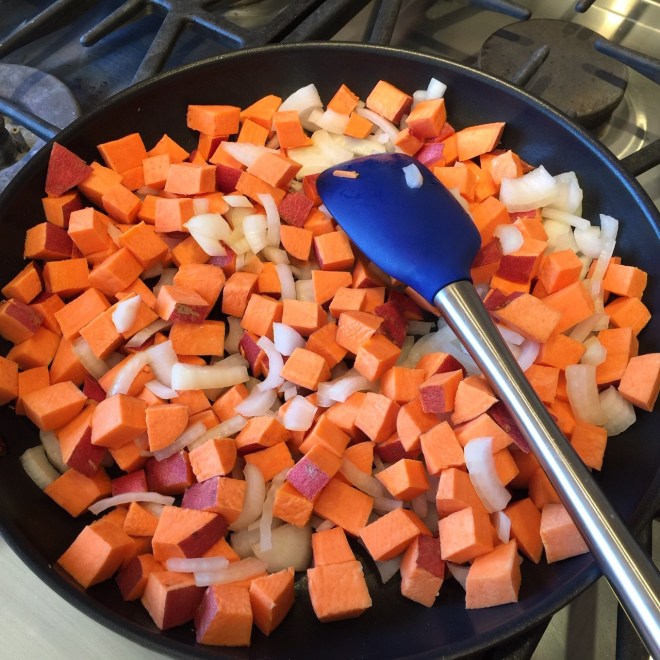 Cover, decrease heat to low, and cook for 8 minutes. Check to see if sweet potato is easily pierced by a sharp knife. If not, cover and let cook a little longer.
 When cooked, add in apples, cinnamon, salt, and dill.
 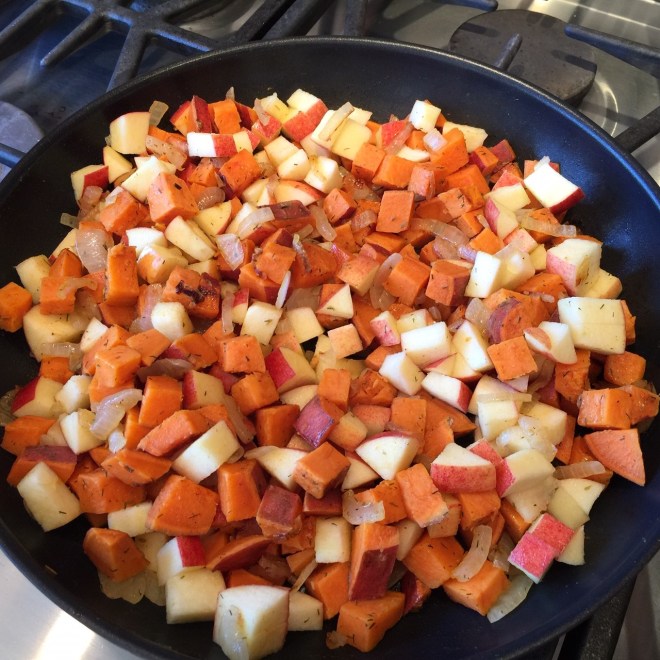 Increase heat to medium/high and sauté until browned, stirring now and then. Add in lemon juice.
 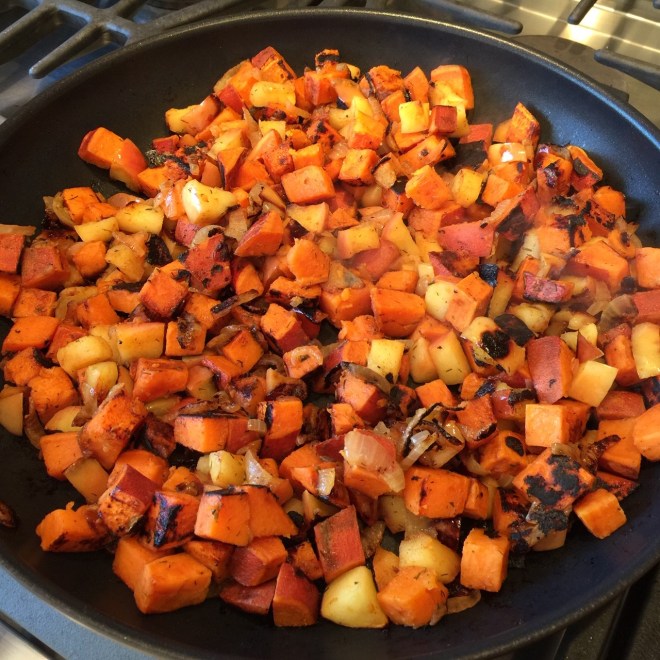 Adjust seasoning, if needed.
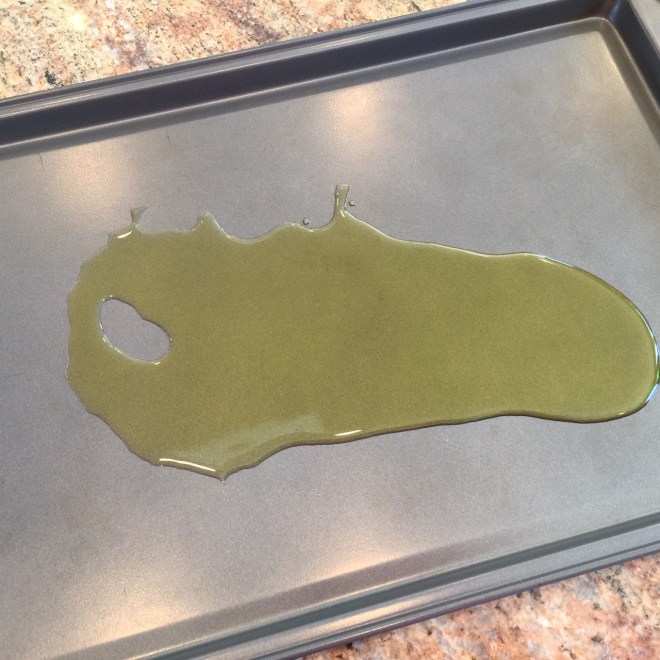 Into the workbowl of your food processor (or a large mixing bowl if you’re going to do this by hand), put the flour, 1 T olive oil, yeast, sugar, and salt. Turn the machine on and slowly pour in the water through the pour tube. Once all the water is poured, let the machine run another 30 seconds or so. This is a very sticky, loose dough.
 Empty the dough onto the olive oil in the jelly-roll pan. Dip your finger tips into the oil so the dough won’t stick to them, and flip the dough so it’s now completely covered in oil.
  Cover either with plastic film or a large pan (I use a rectangular roasting pan – it fits perfectly.) DON’T use a tea towel – it will just stick to the dough. (Been there, done that!) Let rise about 45 minutes.
 Sprinkle on mozzarella, then drizzle on the marinara, followed by any other topping, and finally sprinkle on the Parmesan.
  Bake at 500º F in the lower third of oven for 13-15 minutes. Sprinkle on fresh basil.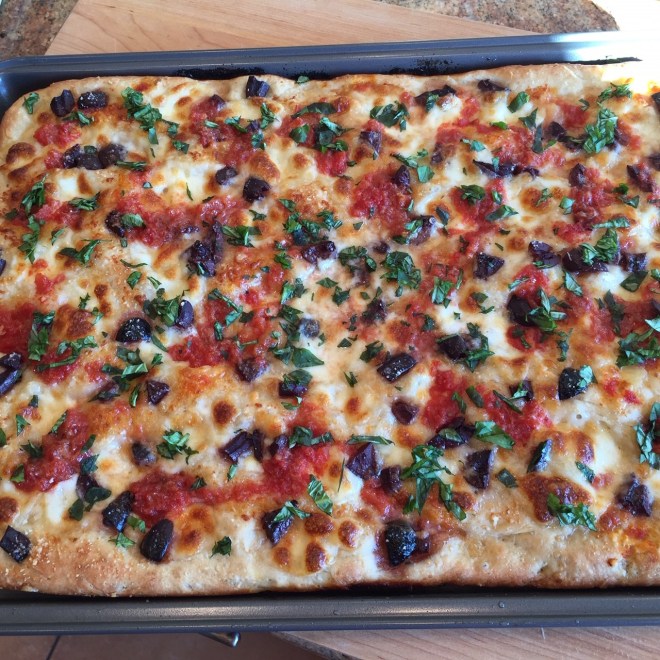

 In a 12″ skillet over medium/high, heat oil. Add onions and sauté until translucent, but not browned – about 5 minutes. Turn off heat and add in garlic and basil, stirring to bloom by using residual heat from the hot skillet.
 Turn heat to medium/high and add in cauliflower. Sauté for 5 minutes.
 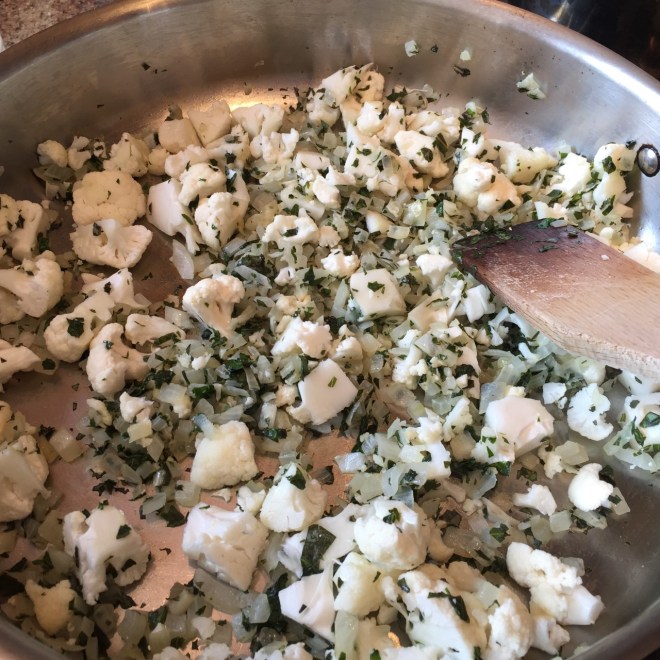 Add in the tomatoes and continue to cook until cauliflower is tender – about 10 minutes.
  In a saucepot, bring 2 quarts of water to a boil. Add in 1 T salt and the pasta. Cook until slightly under-done. Drain.
 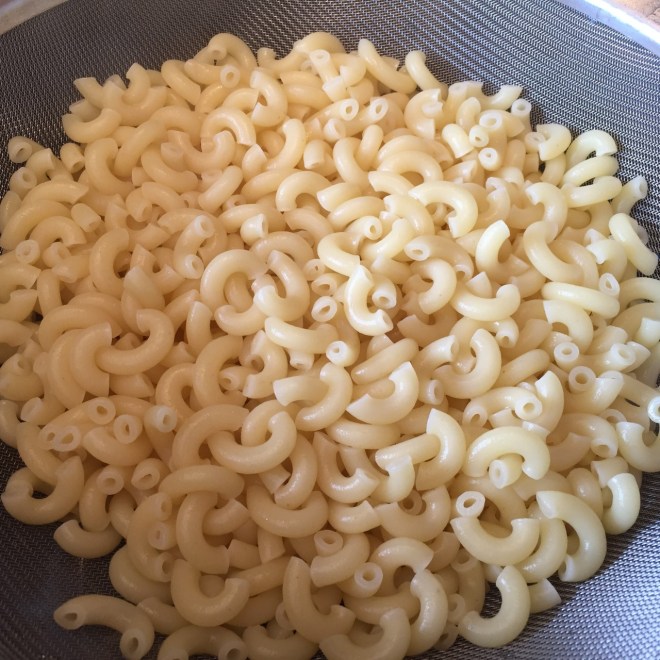 In the now-empty saucepot, combine the white sauce, cauliflower mixture, pasta, and lemon juice.
  Pour half into a casserole dish. Sprinkle on half of Mozzarella and half of Parmesan.
  Cover with the remaining pasta mixture and top with the remaining cheeses.
  Cover and bake at 375º Fahrenheit for 30 minutes. Remove lid and cook 10 minutes longer, if covering with crumb topping. Evenly sprinkle topping over top. Return to oven, uncovered, and bake another 5 minutes.
  If not covering with topping, bake uncovered for 15 minutes.
 Let set 15 minutes before serving – it’s super hot! Pass around Seasoned Breadcrumbs, if desired.
 Remove from heat and pour into a bowl. Stir in Parmesan when crumbs are cooled.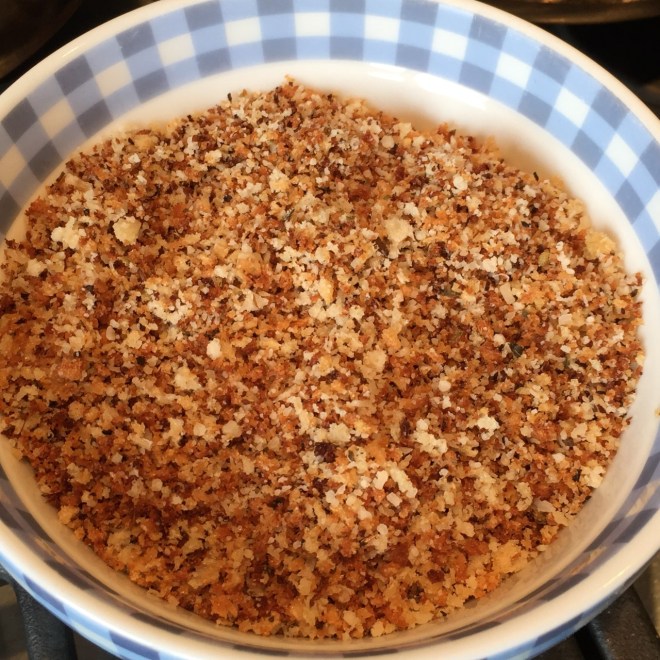
 Some people become vegetarians because they don’t like meat and/or it upsets their body. Not me. I grew up eating some sort of animal everyday – sometimes three times a day and loved it. So when I decided, for humanitarian reasons, to become a vegetarian, it was quite an adjustment.
 Put the butter, rye flour, sugar, salt, caraway seeds, mustard, and 1 cup of the AP flour into the workbowl of a food processor.
 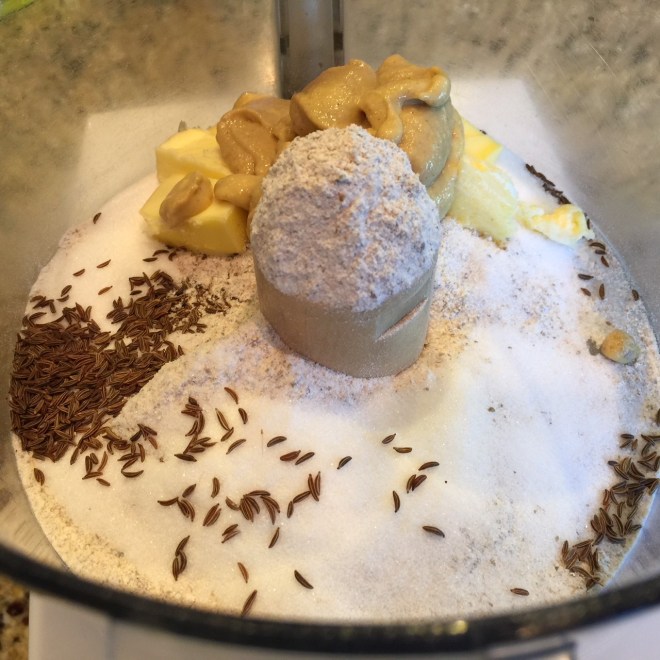 When the yeast is proofed, turn on the machine and slowly pour in the yeast water.
  When it’s mixed, add in remaining flour a little at a time, until dough starts to pull away from the sides. You may or may not need all of the remaining cup of flour.
 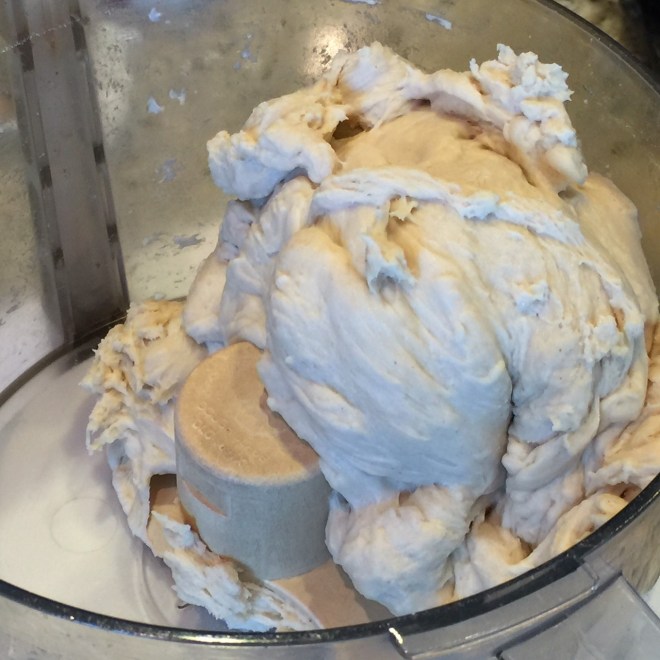 Empty dough into greased bowl, flipping dough ball so entire ball is greased. Cover with tea towel or plate and let rise 1 hour.
 Spread on the “ham”, cheese, then pickles down the center of the dough. Make 1½” cuts along both sides – cut the same number for both sides.
 Fold in one end, then grab the first dough tabs and twist them together, pinching to make sure they stay.
  Keep doing this for all the tabs.
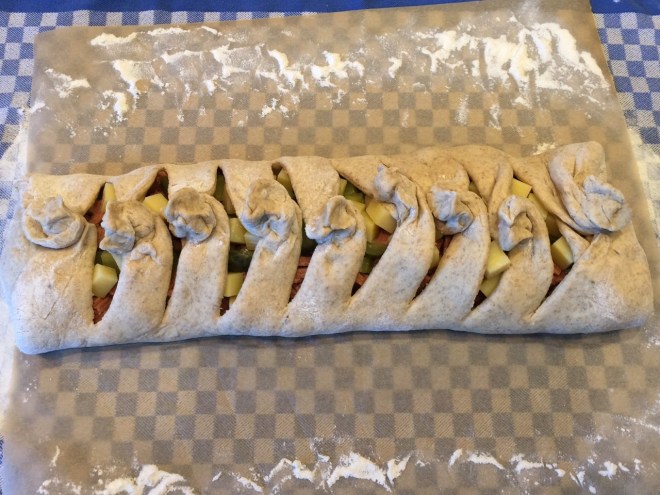 Slide the parchment onto a large, rimless cookie sheet. Cover loaf with the tea towel and let rise 30 minutes. At this time, preheat oven to 375º F.
 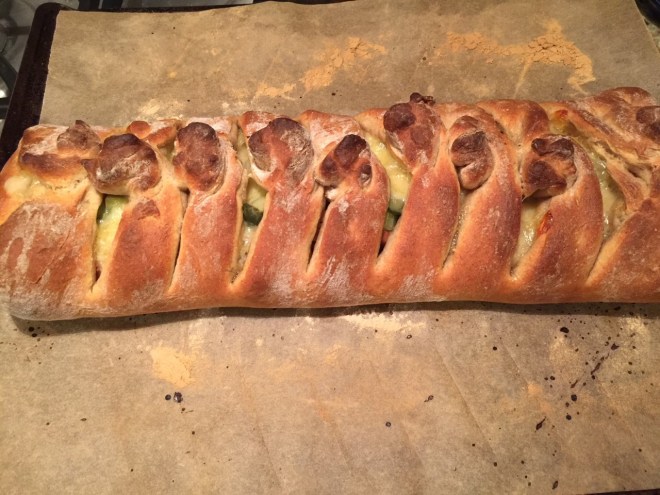 Remove to rack and let set about 15 minutes before serving.
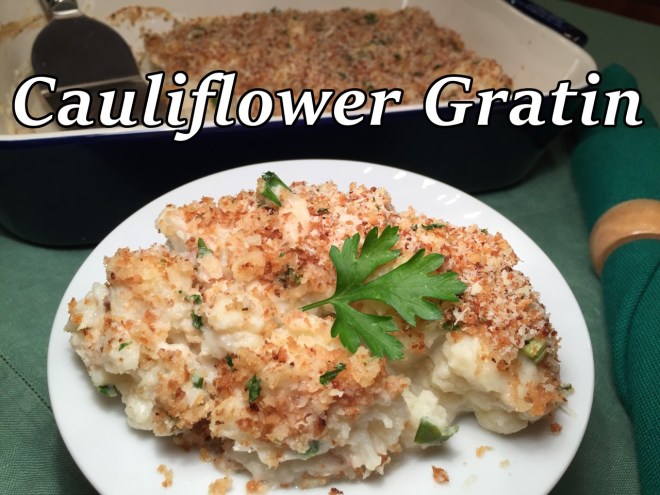 As so often happens, I got the idea for CAULIFLOWER GRATIN from America’s Test Kitchen. Rather than using cream or milk for the sauce, they pureed some of the cauliflower with water to get the liquid. Brilliant!
 Slice off and discard the discolored end of core. Then slice remainder into 1/8″ thick slices.
  Place cauliflower right side up and slice into 3/4″ slabs. Remove florets from stalks. Cut the stalks into 1/8″ slices and place them with the core pieces. (The stalk and core pieces will become the basis for the sauce.)
 Into a Dutch oven, place 3 cups of water, 6 T butter (cut into pieces so it melts faster), all the sliced stalks and core pieces, and 2 cups of the florets. Bring to a boil.
 Place the remaining florets on a large steamer basket. (It’s a bit of a balancing act!)
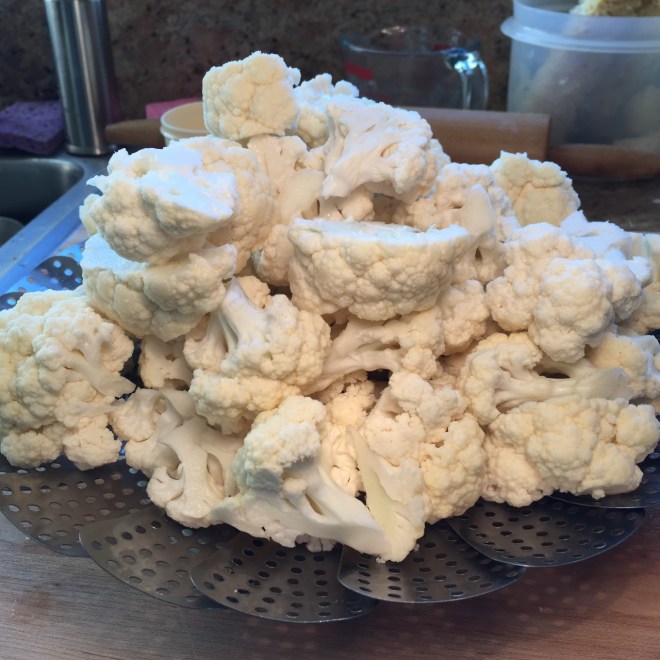 When water/core slices comes to a boil, carefully place steamer basket in Dutch oven. (You may need to remove some of the florets before placing the basket in the Dutch oven – they tend to roll – then replace them once the basket is set in place.) You’re going to steam the florets and boil the core/stalks at the same time.
 Cover and let cook until florets are easily pierced with a sharp knife (about 15 minutes). Don’t undercook the cauliflower in the hopes it will continue to cook in the oven – it won’t.
 When florets are tender, remove steamer basket from Dutch oven and pour cooked florets into a large bowl. Add in the scallions.
 Check to see if the stalks in the water are tender (mine always are). If not, cover and continue to cook until they are tender. Remove lid and let cool about 10 minutes.
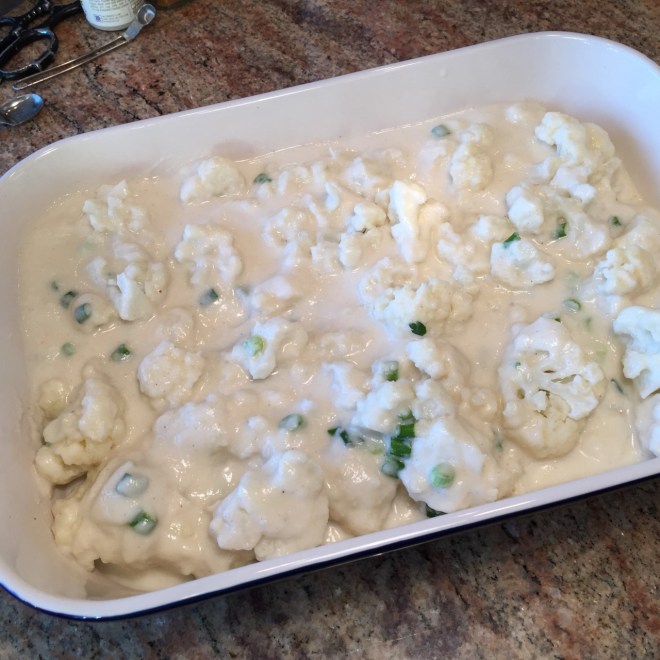
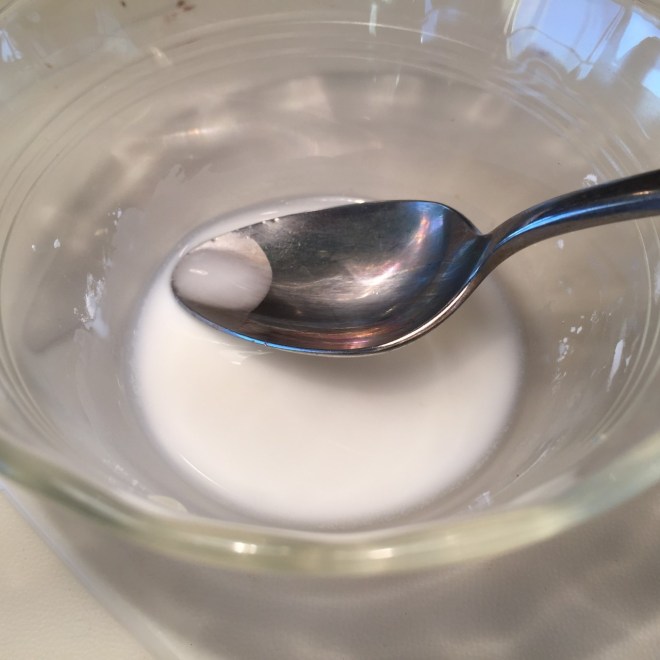 Pour this into the blender, then blend another minute. Pour sauce into the bowl with the florets and gently mix (you don’t want to break the florets).
 Empty mixture into a 9″ x 13″ casserole dish.
 Into the cooled panko stir remaining Parmesan (1 cup) and chopped parsley.
 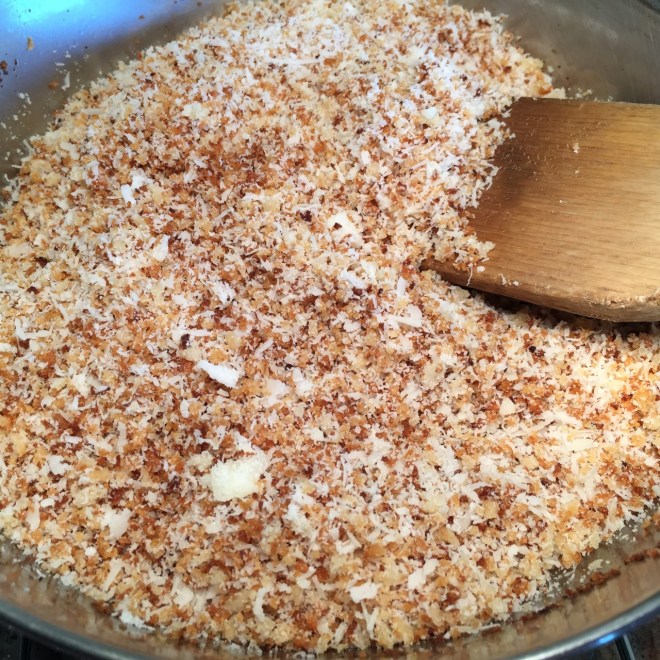 Sprinkle evenly on top of cauliflower.
  Bake, uncovered, at 400º F for 15 minutes. Remove from oven and let set 20-25 minutes before serving.
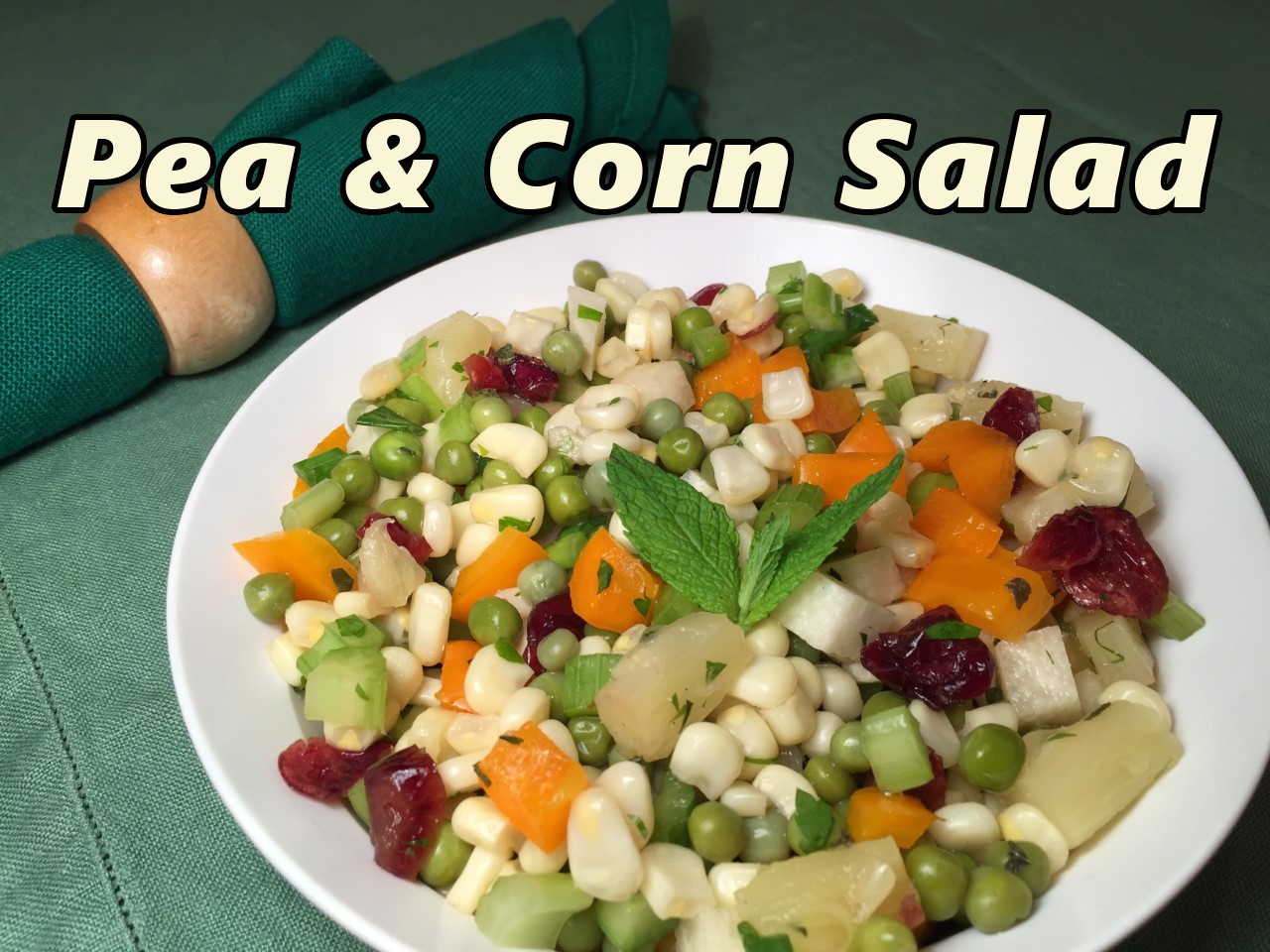 When the weather is hot and you don’t feel like cooking a vegetable, try this non-cook vegetable salad. BONUS: it’s fat free!
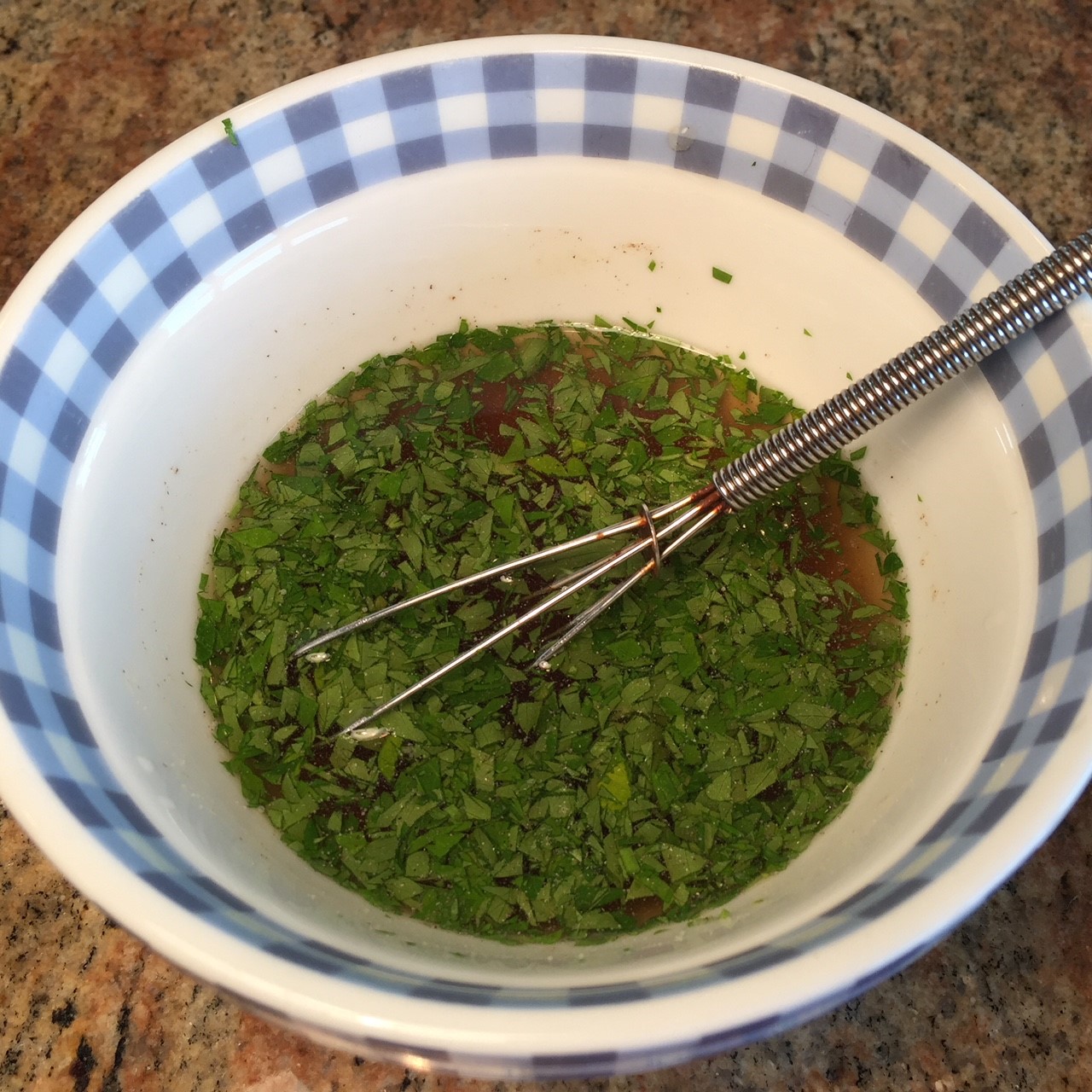
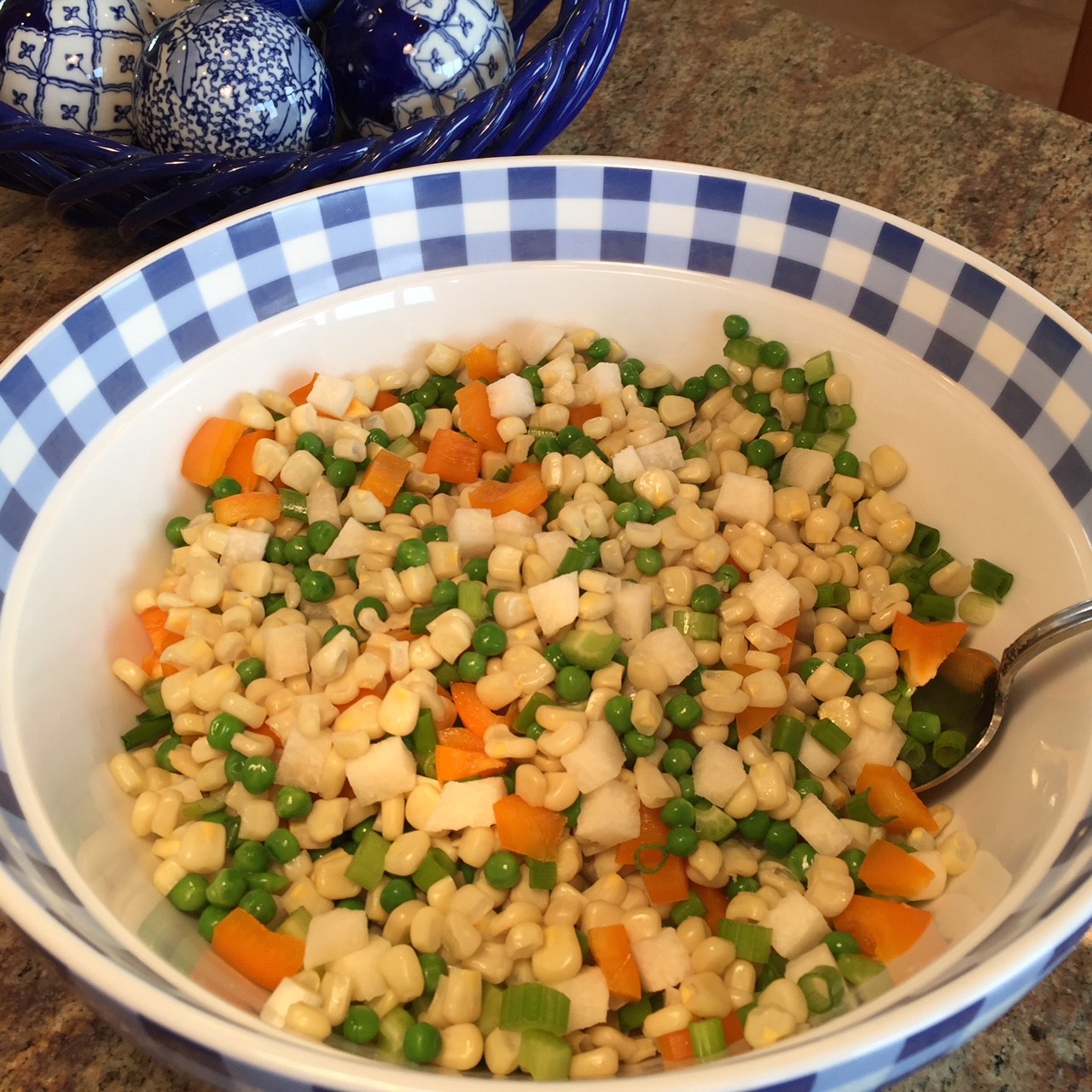 In a small bowl, stir together the vinegar, brown sugar, parsley, salt, and pepper.
 Pour on veggies and blend.
 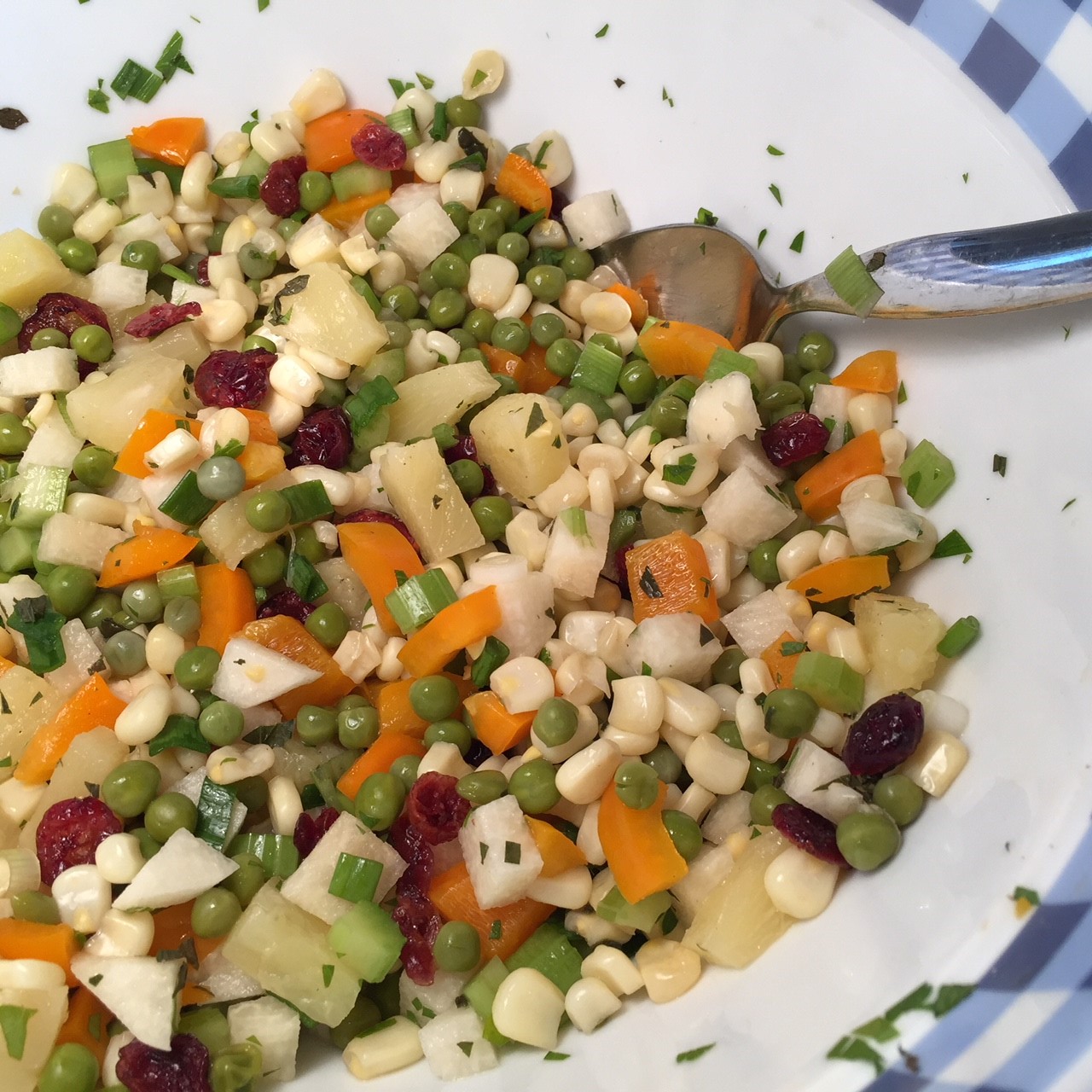 Refrigerate at least 2 hours. Stir in mint and serve.
 Vegetarian Cooking For Carnivores BLOG