Chilly Weather Is Chili Weather!

IMG_0451

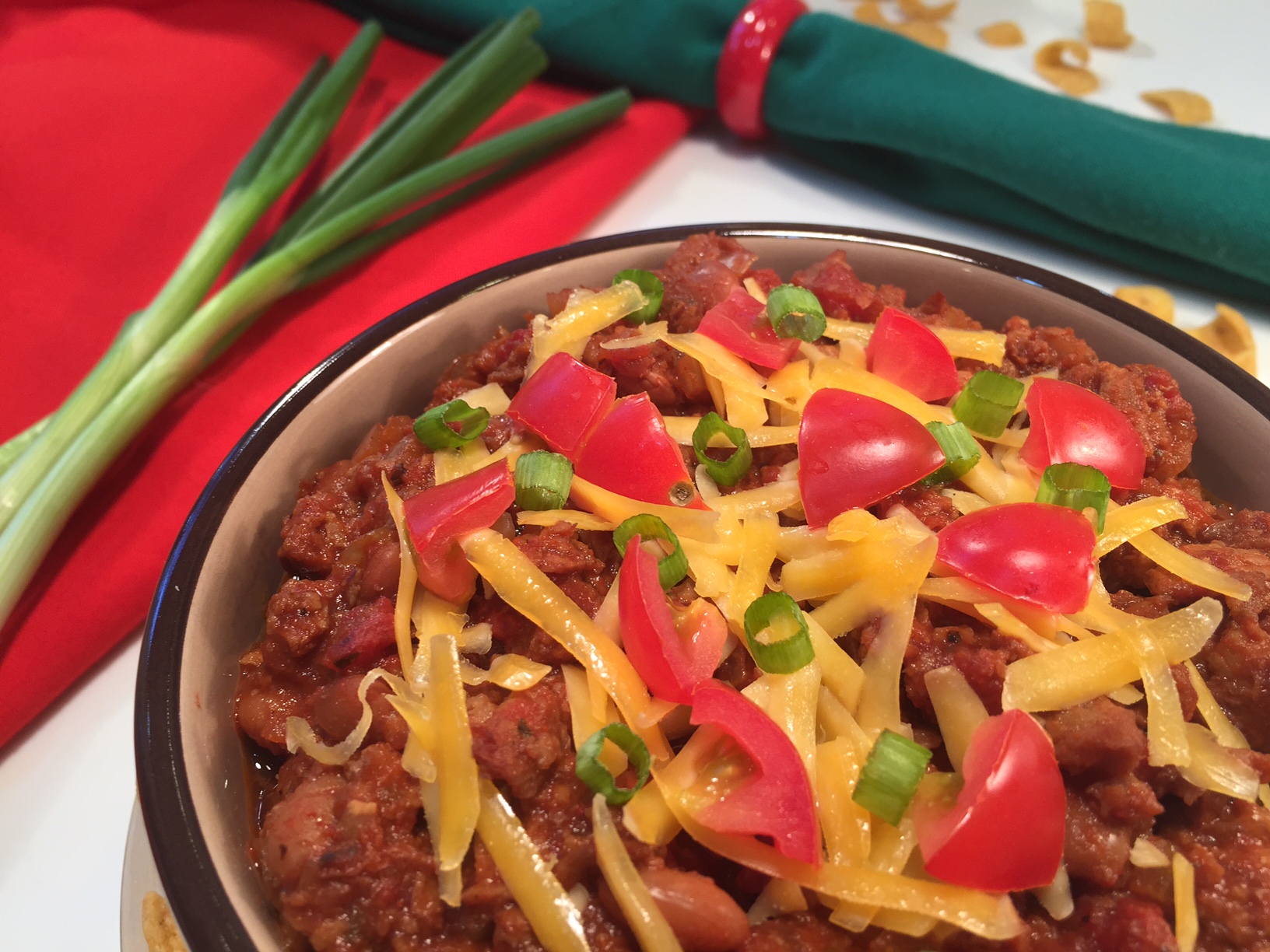
When the weather turns teeth-chattering, there’s nothing like a big bowl of hot and hearty chili. It’s almost obligatory. Can’t you just picture it? Howling wind and pouring rain outside. You huddled beside a roaring fire, woolen blanket on your lap, fortifying yourself with a thick chili topped with cheese and maybe a few (which translates to a large handful) Fritos.

As an ex-carnivore who still has fond memories of chili teeming with beef and/or pork, I just couldn’t accept the typical vegetarian version which generally replaces the meat with various vegetables such as zucchini, eggplant, and carrots. Now, I love vegetables as much as the next person, but there’s no way a mushy zucchini or eggplant will have the same bite as meat.

That’s where imitation meats (heretofore referred to as ‘fake’) comes in. Their purpose is to serve as foundation for the other ingredients in a dish by offering a texture similar to the real thing – without leaving a taste in your mouth that makes you run to the nearest sink to empty your mouth. Been there, done that!  If you’ve tried a fake chicken, for example, that brings to mind cardboard – try again with a different brand. Or, perhaps, try cooking it less. Fifteen seconds too long with fake hamburgers can turn a tender patty into a hockey puck.

Fortunately, my chili recipe calls for ground “beef”. (Reminder – quote marks mean fake.) Since all the ingredients simmer together, there’s no worry about overcooking. I love using Morningstar’s Crumbles (found in the frozen food section), but since taste is subjective, use what suits you.

This dish is one of those throw-everything-together-in-a-pot-and-then-simmer recipes. And, unless you have the flame too high and forget to stir, it’s fail proof. If you like this chili, I wouldn’t be living up to my title of Queen of Freeze if I didn’t recommend doubling or tripling (which is what I do) the recipe, then freezing in portion sizes for future use. Cook once, clean once, enjoy homemade meals for months to come!

NOTE: Because I’m a bit obsessive about saving money (cheap!) and cooking from scratch, I buy raw pinto beans and cook them myself ahead of time. It takes about 1½ cups of uncooked beans to make the 2 cups called for. If you’re going to do this, allow a couple of hours, at least. No surprise, I actually buy a large bag of beans, cook the entire amount, then freeze the unused in 1 cup increments.

BONNIE’S VEGETARIAN CHILI – makes 9 cups

  • 2 lbs fake ground beef (I use 2 pouches Morningstar Crumbles)
  • 2 cloves garlic, pressed
  • 1 onion, chopped (I use my food processor to finely chop)
  • 1  28-oz can whole tomatoes, chopped (remove stem end, skin, & any flaws)
  • 1  15-oz can tomato sauce
  • 1½ tsp dried oregano
  • 1 tsp cumin
  • 4 T chili powder
  • 3 T paprika
  • ¼ tsp ground pepper
  • 1 T salt
  • 2 cups cooked pinto beans

Put all the ingredients into a large stockpot. Bring to a boil over a medium heat, stirring now and then. Lower the flame to keep chili at a simmer, uncovered, for an hour. Stir often enough that the bottom doesn’t burn. A flat headed wooden stirrer is perfect for this.


Kitchen Gifts For Giving Or Receiving

kitchen gifts2

It’s that time of year when we rack our brains trying to come up with gifts for our friends, loved ones, and conversely, for ourselves.

I’m a practical person and love gifts that serve a purpose. Maybe it’s a sign of getting older, but just how many knick-knacks does one need? So, today’s blogpost is a list of kitchen items that (in my opinion) every well-stocked kitchen should have. They range from inexpensive to pricey, and are listed in no particular order. There is a multitude of other kitchen equipment that can be bought and, naturally, I own many of them. But this is a list of my must-haves:

NOTE:  You won’t see a bread maker on my list. They’re expensive, bulky, heavy, and can only do one thing:  make bread. The most difficult thing about making bread is kneading it – you can do that in a food processor.

  • FOOD PROCESSOR – (Did you notice the nice segue way?) I love my Cuisinart, but there are many brands. It can be used to knead dough (bread, pizza, tortillas, pasta), chop vegetables (tomatoes, onions), purée (hummus, soup), shred vast quantities in seconds (carrots, cheese, cabbage), finely grind (graham crackers, nuts), and, I’m sure, other things for which I don’t need.  I use mine almost daily!
  • BLENDER – I actually own 2:  the large jet-engined VitaMix, and the smaller Oster.  I use them both. The VitaMix is great for yogurt shakes (which I make almost daily) because it can handle the ice cubes. Also, because it has such a large pitcher I can blend soups, etc. in fewer batches. On the other hand, I use my smaller Oster to make small batches of soup or pesto (even if I triple the recipe, it’s still not enough for the VitaMix.)
  • COOKIE SHEETS – You should have at least 2 flat sheets and 1 jelly-roll pan (it has 4 sides). I generally prefer to use my dark non-stick sheet – cookies cook a little faster, brown better, and I don’t have to grease the pan. But sometimes you don’t want any of that, so it’s good to have the silver kind, too. Don’t waste your money of the cushioned kind – it has a layer of air between 2 sheets. It’s not that they’re bad, it’s just that things don’t cook any better on it. Save your money.
  • PIZZA WHEEL – This is not just for cutting pizza. I use mine for quickly slicing dough, such as when I make Corn Dogs.
  • GARLIC PRESS – There are several different types. Make sure you get a sturdy one – these things have to undergo a lot of pressure. I use mine all the time.
  • POTS AND PANS – This is an obvious need for a kitchen. It’s nice to have a variety of sizes. I use the 1 quart size the most and own 4. The 1½ qt., 2 qt.,  3 qt., and Dutch ovens often come as sets and are worth the money. An ultra large stockpot is invaluable to me for making huge batches of spaghetti, chili, and vegetable stock so I can freeze it in portion sized containers for future use. I also love the tiny ½ cup and 1 cup sizes for melting butter. A 10″ skillet is a must for sautéing and making omelettes. Brands where the lids are see-through and have a steam escape hole are great. I also love handles that are metal, so they can go in the dishwasher. My black-handled Revere Ware pots are greyed and getting brittle after years of dishwasher cleaning.
  • ELECTRIC FREE-STANDING MIXER – Absolutely essential for making cakes, cookies, frosting, whipped cream, and meringues. Don’t get a hand-held. Yes, they’re much cheaper, but you’ll never use it because when mixing you need one hand to scrape and one hand to turn the bowl. There are no hands left to hold the mixer. Plus, it gets heavy even after a short while. As to brand, I cringe when I see the price of KitchenAids. Outrageous! They’re not worth it. I’m still using the Sunbeam I’ve had my whole adult life. You don’t need a motor that powerful to beat cake batter. Sure, KitchenAids come with dough blades, but use your food processor for kneading dough.
  • MIXING BOWLS – You can never have too many. A set of pretty nesting bowls are nice for presentation and usage. Add to that a variety of different sized glass bowls. It’s nice to have at least one huge bowl – it doesn’t get used that much, but comes in handy now and then.
  • MEASURING CUPS – There are different cups for dry and wet ingredients. You’ll need both. Cups for dry ingredients come in nesting sets and are flat on top so you can level off the excess.. I have 4 sets and it’s the perfect number for me. Nothing is more frustrating than needing a ½ cup for sugar after you just used it for shortening. The best sets include ¼ cup, 1/3 cup, ½ cup, 2/3 cup, ¾ cup, and 1 cup. Measuring cups for wet ingredients have a handle and spout. You’ll need at least one of a 1 cup, 2 cup, 4 cup, and 8 cup. The larger ones should be plastic because they’re lighter and easier to manage.
  • MEASURING SPOONS – You should have at least 2 sets. The best kind are metal and have the size etched into them. The paint eventually wears off the plastic ones making it hard to figure out the size. A set that includes 1/8 and 3/4 tsp, as well as the usual sizes is the best.
  • LARGE WOODEN BREAD BOARD – Not only can this be used for rolling out dough, but you can cut fruits and veggies on them. I make so much dough that I keep a floured board in a large drawer I had specially made. Before that, I put brackets under my overhead cabinets so I could slide it in and out without throwing out the flour.
  • PASTRY SHEET – These are great for rolling out pie crusts. Mine is Tupperware, but there may be other brands out there. To dispose of leftover flour, just lift up the sides and empty into the trash. The sheet folds up small and can be stored away easily.
  • MUFFIN PANS – Cupcakes are very popular nowadays. I made the switch from whole cakes to cupcakes – they’re great for portion control. One cupcake = 1 serving. Done. Two pans are nice so you don’t have to cook in batches.
  • LOAF PANS – These are great for baking bread, “meat”loaves, quick breads, and loaf cakes. They come in glass and metal. I really don’t have a preference. I own both and generally use the glass.
  • POTATO PEELER – This is just a small item, but essential for peeling potatoes, yams, apples, and carrots. You don’t need an expensive one – the cheapies work well.
  • GRATER – I use mine constantly for grating cheese, and occasionally for a small amount of shredded carrots. (I use the food processor when I need a larger amount.) Buy one that has small holes (for hard cheeses) and large holes (for soft cheeses). I don’t like the kind that have four sides and stand upright – I tend to cut myself with those.
  • DEEP FREEZER – Okay, this is a large item but if you have room, I highly recommend them. Not only can you stock up on flours, frozen foods, and leftovers, you can cook multiple batches of foods that freeze well (such as spaghetti sauce and chili), and then freeze in portion sized containers. Cook and clean once, then eat for months to come. Just because you’re tired doesn’t mean you can’t have a home-cooked meal.
  • STORAGE CONTAINERS – You can never have too many containers – everything from ¼ cup size up to giant cake holder size.
  • SIEVES – These are necessary for draining. It’s nice to have a large, medium, and tiny size.
  • WOODEN STIRRERS – Using wood prevents scratching up your pots and pans. You should have both spoons and flat stirrers, and at least two of each. The more expensive ones aren’t necessary – the cheap ones work fine.
  • ROLLING PIN – Absolutely needed for rolling pie crusts, some cookies, and tortillas. They have marble ones, but I don’t like them.  They’re heavy, expensive, and break if you drop them. The wooden ones work best.
  • TOASTER OVEN – Rather than having a pop-up toaster, the toaster oven will do the job of making toast, plus a multitude of other tasks. I’ve never had much luck with baking in them, but I toast nuts, cook fake bacon, and make toasted open faced sandwiches in it. Mine is used nearly everyday. It’s better to use the toaster oven than heat up my big oven for small things.
  • THERMOMETER – After years of using and breaking the glass candy thermometers, I finally bought a digital one. It’s fabulous. Mine adjusts for Celsius and Fahrenheit, which is nice.
  • WIRE RACKS – You need at least one large one or two smaller ones. Baked goods need to be cooled on a rack to set properly.
  • UTENSILS – You can never have too many spatulas, slotted spoons, tongs, wine bottle openers, etc.  It’s a giant category – not very exciting but extremely necessary.

And that’s my list! Repeat: MY LIST. I’m sure there are those of you out there who couldn’t live without your tortilla maker or mortar & pestle. We all have different wants and needs. But I guarantee, just about any item on this list would be welcomed by most people who actually use their kitchen for cooking. Happy shopping!


Think Outside The Box Spaghetti

Spaghetti with 'Meat' Sauce

Spaghetti with ‘Meat’ Sauce

I’ve mentioned before that my mother was NOT the most adventurous cook. It wasn’t that she was a bad cook – she was just a nervous cook.  Afraid to try new things.  Plus, she was a product of the modern world of boxed, canned, and frozen foods. She bought into the idea of why take the time and trouble to make something yourself when a large corporation (whose only concern was to make a profit) could do the work for you.

We kids didn’t mind.  After all, we could pick out specifically what frozen dinner we each wanted – some of them even had a little dessert! The only fresh vegetable we ever had was corn on the cob – when it was in season. The rest of the time we had canned green beans or peas. I’d never even heard of broccoli or cauliflower before I left home.

Which brings me to my spaghetti story.

As probably most of you know, when you have to start paying your own bills you really take notice of how much things cost. Fortunately, I was born with a dominant frugal gene (yeah- cheap, okay?). I figured out pretty quickly I was going to have to learn how to cook.

One thing my mother made was spaghetti. She used Kraft Spaghetti, which came in a box, and she added ground beef. It was good, and all I knew. So I decided to make spaghetti and bought the box of Kraft, the ground beef, and made my spaghetti. It was good – again, it was all I knew.

Then one day in the supermarket I happened to notice plastic bags full of dried spaghetti noodles.  What the heck was this? Why are these spaghetti noodles all by themselves and not packaged in a box with a can of sauce?, I wondered.  (You’ll be happy to know this was only said in my head…THAT time, anyway.) It took awhile, but it eventually dawned on me:  I could make the sauce FROM SCRATCH and buy as many noodles as I wanted. (It took many more years to figure out I could actually make the pasta, too.) It honestly never occurred to me people made spaghetti sauce.

Once enlightened, I tried various spaghetti sauces through the years. When I became a vegetarian, the problem became that without the meat, it was really just a marinara sauce.  Having grown up with a nice hefty meaty sauce, plain old marinara sauce just seemed kind of empty. It was tough being a vegetarian in the early days.

Fast forward to my discovery of fake meats (‘faux’ to you posh people), which greatly expanded my vegetarian recipe repertoire.  I’d already started using Loma Linda’s Redi-Burger in my ‘Beef’ Salsa Burritos (remember, quote marks denotes FAKE) and my Navajo Tacos. But it didn’t seem like a good choice for my spaghetti sauce.

I guess good things come to those who wait because, low and behold, in the frozen food section I found Morningstar’s Griller’s Recipe Crumbles.  They come in a pouch and are like ground beef that’s already stir fried (minus the fat).  So it’s a snap to use – no frying, no wondering what to do with all the grease.  Just open the pouch and pour out the ‘ground beef’.

Thanks to these Crumbles, my family can now enjoy a delicious Spaghetti With ‘Meat’ Sauce. I’ve come up with a recipe in which I  simply throw everything in the stockpot and cook for an hour.  As always, when I make something that freezes well, I make a vat of it and freeze it in meal sized portions.  No point in cleaning the pot and utensils more than once.  Making a multiple batch is not that much more work.  Once I’m done, I have enough spaghetti sauce for months!

I’ll give you the recipe for both one batch and six batches (that’s what I make).  I would suggest you make the one batch version first, just to make sure you like the recipe.  If you’d like to see my video of me making this dish, click on: Spaghetti With ‘Meat’ Sauce.

NOTE:  If you want to save about 20 minutes, and are NOT obsessive and paranoid like I am, then buy the canned tomatoes diced instead of whole.  I buy the whole so I can inspect each one and cut off any imperfections and the stem end. Also, you can buy garlic already minced in a jar. It took me 35 minutes to put all the ingredients in the stockpot. You can see where most of the time was spent.

ADDITIONAL NOTE:  It doesn’t matter what kind of red wine you choose.  Just make sure it’s a wine you would actually drink because the flavor will come through.  I usually use Black Mountain cabernet sauvignon – it’s reasonably priced and has a nice taste.

WILL SHE EVER STOP TALKING ADDITIONAL NOTE:  You can either buy vegetable stock OR do what I do and make your own.  Click on: Back To Basics: Vegetable Stock for my recipe.

SPAGHETTI WITH ‘MEAT’ SAUCE 

1 BATCH VERSION – makes 3 cups

  • 1 pouch (12 oz / 340 grams) Morningstar Griller’s Recipe Crumbles
  • 1/3 cup (80g) extra virgin olive oil
  • ½ cup (125 ml) vegetable stock
  • 1 clove garlic, pressed
  • 1 tsp each of dried oregano, dried basil, and salt
  • 1 bay leaf
  • ½ cup (122g) tomato paste
  • 2 cups (528 g) canned whole tomatoes
  • ½ cup (125 ml) red wine
  • 1/2 tsp red pepper flakes

6 BATCH VERSION – makes 18 cups

  • 6 pouches (each pouch is 12 oz / 340 grams) Morningstar Griller’s Recipe Crumbles
  • 2 cups (475 ml) extra virgin olive oil
  • 3 cups (720 ml) vegetable stock
  • 2 T minced garlic
  • 2 T each of dried oregano, dried basil, and salt
  • 6 bay leaves
  • 4   6 oz (170g) cans tomato paste
  • 4   28 oz (793g) cans whole peeled tomatoes, chopped
  • 1 bottle red wine (YES – a whole bottle!)
  • 1 T red pepper flakes

Throw everything in a stockpot and bring to a boil. Lower flame enough so the sauce continues simmering. Cook for 1 hour, stirring often – you don’t want the bottom to burn. Done!!!

IMPORTANT NOTE (this is the last note, I promise):  Make sure you remove the bay leaves before serving the ‘Meat’ Sauce.  Actually, I kind of enjoy the fishing expedition I go on trying to find my 6 leaves. (Shows you how exciting my life is!)  The last leaf is always the hardest to find.

Beer & Cheese Omelette Casserole – Perfect For Brunch, Lunch, Or Dinner!

Beer & Cheese Omelette Casserole

Beer & Cheese Omelette Casserole

Don’t get me wrong – I LOVE Beer Bread.  But you can only eat so much of it before you start wearing it…on your hips.  You know what I’m talking about.  You keep eating something because it’s going to go bad if you don’t.  And, of course, it really tastes better slathered with butter (well, what doesn’t?).

I made Beer Bread the other day (click: Beer Bread – No Need To Knead) and there was still half a loaf left.  I thought about freezing it – I AM the queen of freezing, after all – but wondered if I could use it for dinner somehow.  I perused my recipe cards (for you young folks out there, recipe cards are what we used before the internet).  When I came upon Briggs House 24-Hour Wine And Cheese Omelet I had a ‘hmmm’ moment.  The recipe was an egg casserole with pieces of day-old French bread and white wine, among other ingredients.  I said to myself (and, yes, I talk to myself), ‘How would this taste if I replaced the French bread and wine with beer bread and beer?’  The recipe also called for Swiss cheese.  I wasn’t sure how Swiss cheese would taste with the beer flavor, but I did have jack with jalapeño.  ‘Hmmmm’ (once again – this time with an added ‘m’)….’now that might give it a bit of a kick’.

The final change was made out of necessity.  As the name indicates, you put together the original in advance and then let it rest 24 hours before baking it.  (It’s one of those handy recipes for brunch when you won’t have time to cook.)  It was coming on to the dinner hour so I didn’t have time for it to even take 40 winks, let alone a 24 hour rest.  Once I put it together, into the oven it went.

The final verdict?  It was good.  Very good.  But I have to say, I prefer the French bread and white wine taste.  Maybe next time I’ll split the difference and use beer bread with white wine.  My husband will appreciate that – I had to beg ¼ cup of the beer he was about to drink. The jalapeño jack was great, although so is the Swiss.  The Swiss is more subtle, but the jalapeño really wakes your mouth up.  I guess I’ll just have to see what I have in the fridge next time I make it.

Here’s my version of Briggs House 24-Hour Wine And Cheese Omelet.  Of course, as with most recipes, tweak it to suit yourself.

BEER & CHEESE OMELETTE CASSEROLE

  • ½ loaf beer bread, torn into 1″ cubes
  • 3 T butter, melted
  • 2/3 cup jalapeño jack cheese, shredded
  • 8 eggs
  • ¼ cup beer (I used Hefe.  Use a brand you like since the flavor will come through)
  • 1½ cups milk (I used organic nonfat)
  • ½ T dry mustard
  • ¼ tsp cayenne pepper

Preheat oven to 325ºF.

Butter a casserole dish.  I used a 6″ x 11″ dish which makes a thicker casserole.  But you can use the standard 9½” x 13″ casserole dish if you prefer a thinner omelette (or if that’s all you have).  Spread the beer bread evenly in the dish, then drizzle with the melted butter. Sprinkle on the cheese.

In a medium sized bowl beat the eggs.  In a small bowl put the dry mustard and cayenne pepper. Pour in a little of the beer and, with the back of a spoon,  make a smooth paste. Add this paste, the remainder of the beer, and the milk to the eggs.  Beat until foamy.  Pour evenly into the casserole dish.  Cover with foil and bake for 50 minutes covered, then remove foil and continue to bake another 10 minutes, until the top is browned.  Let rest at least 10 minutes before serving.

NOTE:  Next time I make this, I’m going to add in Morningstar’s Veggie Sausage Patties. They would go really well with this dish – and they’re so good, your carnivores will love it!


Beer Bread – No Need To Knead

BEER BREAD

BEER BREAD

Home made bread is one of those things that everyone loves to eat, but most people shy away from making.  Well, have I got a bread for you:  BEER BREAD!   It’s only got 3 ingredients and – like my extremely clever title promises – no need to knead!

Who doesn’t stop in their tracks when they get a whiff of bread baking in the oven?  This is inevitably followed with an audible ‘aaaahhhhh!’  Add in the aroma of beer and people will be lining up for a slice.

This is a super fast and easy bread to make.  For those of you who like to ‘watch’ recipes rather than read them, you can click on: BEER BREAD and watch my how-to video.  (I like the way my hair turned out in that video, btw!)

One of the odd things about this bread is that even if you don’t like to drink beer, you may still enjoy eating Beer Bread.  When I started making this bread, I couldn’t stand the taste of beer (although, oddly enough, I liked the aroma), but I really liked the bread.  Over the years, I’ve grown to like drinking a pale beer now and again – especially on a hot day.

You’ll notice that the recipe calls for self-rising flour.  Make sure you don’t use anything else.  Otherwise your bread won’t rise.  This is one of those specialty flours I keep on hand, stored in the freezer.  (Did you know freezing flour prevents bugs?  I store all my flours in the freezer.)  As far as I know, the smallest size bag of self-rising flour you can buy is 5 lbs. That’s a lot of flour, especially when all you need is 3 cups.  Just suck it up and buy the bag – you’ll eventually use it up.  Once the self-rising flour is awaiting use in the freezer, you can make Beer Bread at the spur of the moment (as long as you have beer on hand….which is a given in my house).  It only takes a few minutes to get it into the oven.

BEER BREAD

  • 3 cups (453g)  self-rising flour
  • 3 T (30g) sugar
  • 1 bottle beer, room temperature and sealed

Preheat oven to 375ºF.

With a spoon, mix the flour and sugar together in a bowl.  Open the beer and pour into the flour all at once.  Immediately begin incorporating the beer into the flour with the spoon. Pour the batter into a greased loaf pan.  Bake for 45 minutes – until golden brown on top.

Take the loaf from oven and let sit a few minutes. Then run a knife around the sides and remove the Beer Bread to a wire rack to cool.

A word of caution:  tempting as it may be to slice into the hot loaf – restrain yourself! Cutting into a hot loaf of bread causes it to fall apart.  And ladies, keep your husband away from it – the aroma of hot bread combined with beer draws them like a magnet.