

Every now and then I challenge myself to improve on a just-okay recipe. In this case, it was my grandmother’s peanut butter buns (she called them ‘josh’, which means ‘snack’ in Armenian). While they were a big hit with her five children and my husband, I felt they were a little dry.
I decided the problem was two-fold: the dry dough and the dry peanut butter filling. Creating an enriched dough seemed the obvious answer to the dough. As for the filling, I considered using a jelly. Then I spied some ripe bananas in the fruit bowl. Hmmm! (Elvis came to mind.) Recalling a contestant on the British Bake Off cooking down bananas to evaporate excess moisture, this seemed like a good idea to prevent a mushy filling while, simultaneously, adding flavor. To give a nod to the classic jelly idea, I tried crushing freeze dried strawberries. The problem was I needed to use a lot to really taste them. As they’re very expensive, I chose to go with the peanut butter and banana on its own. You can add them, if you like.
NOTE: You can substitute a different nut butter, if you prefer.
PEANUT BUTTER-BANANA BUNS – makes 6
Dough
- 121g (1/2 cup) milk, warmed to about 40°C (104°F)
- 1 tsp yeast
- 229g (1.75 cups) bread flour
- 1 tsp salt
- 28g (2 T) butter, room temperature
- 40g (1/4 cup) granulated sugar
- 1 egg white
Filling
- 3 large ripe bananas
- 118 (1/2 cup) peanut butter (or other nut butter)
- 1/4 tsp salt
- Optional: 31g (1 oz) freeze dried fruit, crushed
Prepare the dough:
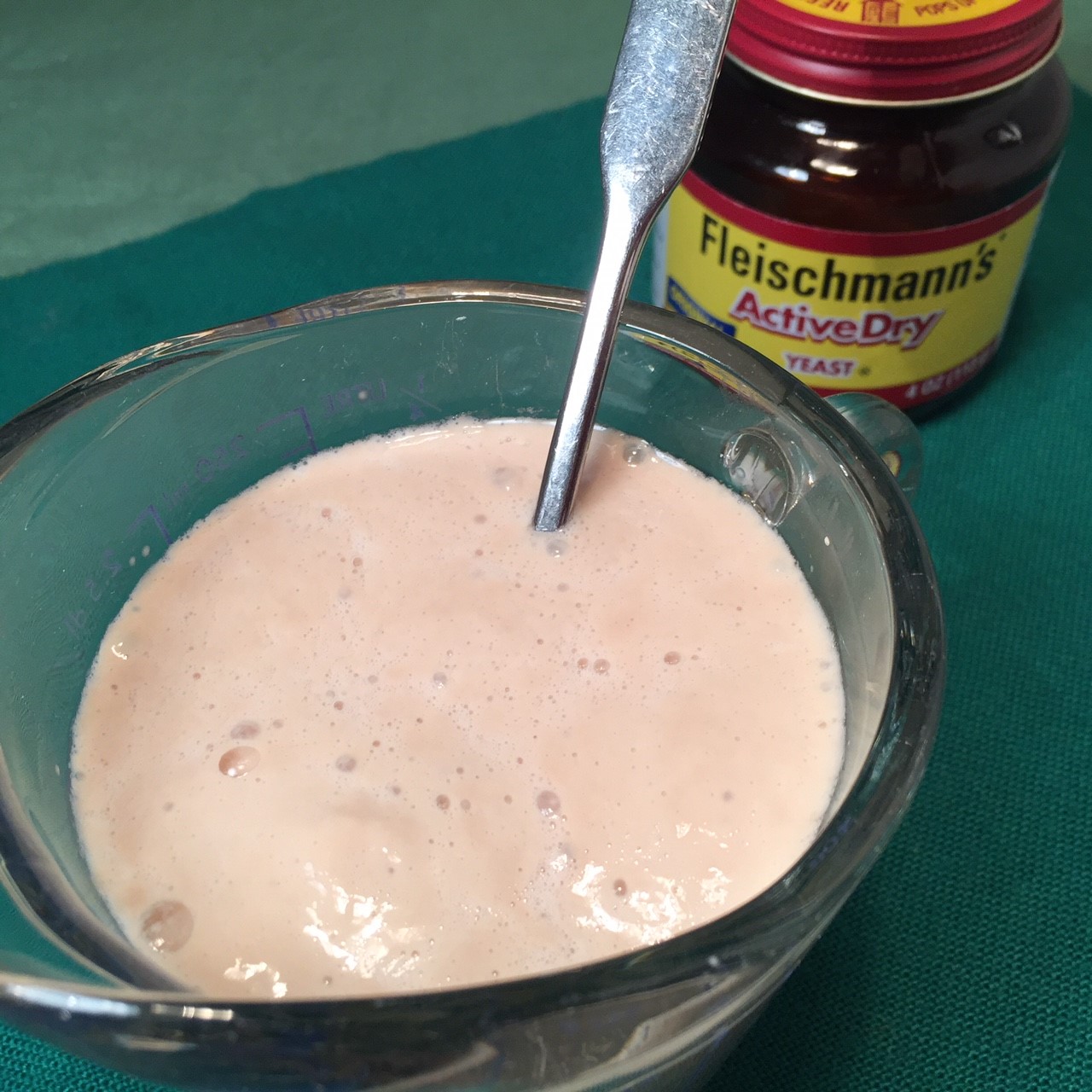
Proof the yeast by stirring the warmed milk and yeast together, letting it set about 5 minutes.

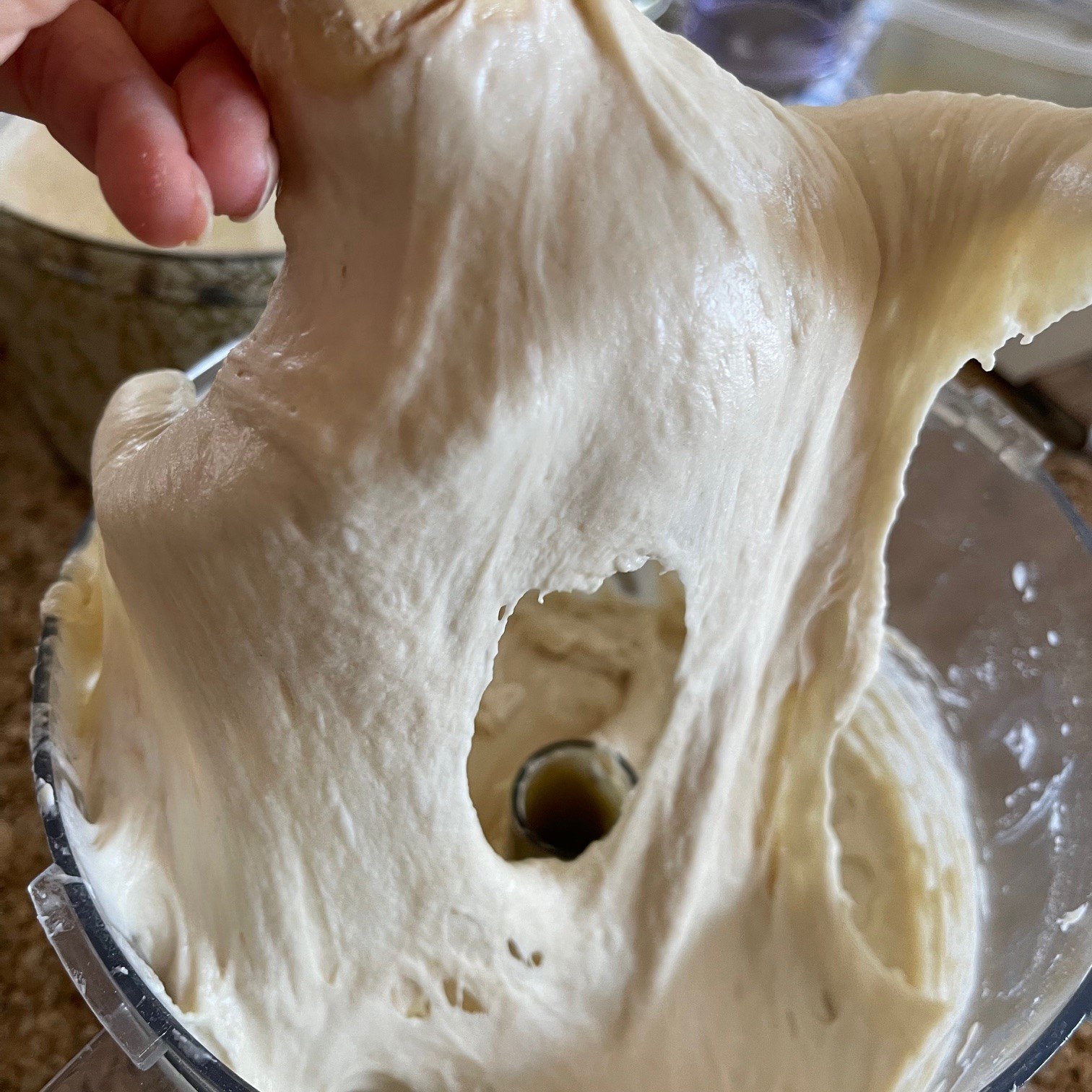
Into the workbowl of your food processor, put the flour, 1 tsp salt, sugar, softened butter, egg white, and proved yeast/milk. Process about 40 seconds, pausing to scrape down the sides as needed.

Empty dough onto lightly floured counter and knead about 6 times to bring dough into a ball. A bench scraper works well for this task.

Place dough ball in a lightly oiled bowl, then flip the ball so both sides are coated with oil. Cover and let rise 1.5 hours on counter.
While dough is rising, prepare the filling:
Into a saucepan, place the peeled bananas. Mash with a potato masher or fork.

Over medium/high heat, cook the bananas, stirring often, until most of the water has been cooked out – about 11 minutes. Remove from heat.

Stir in the peanut butter and 1/4 tsp salt. (If you’re using freeze dried fruit, stir it into the mixture) Chill until dough has finished rising.

Once the dough has risen, assemble the buns:
Empty the risen dough onto a lightly floured surface and divide it into 6 pieces. Roll each piece into a 9″x 4″ (23cm x 10cm) strip.

Divide the peanut butter-banana filling evenly between the strips. Spread the filling over the dough strip, leaving a 1/2″ (1cm) border along all 4 sides. The filling will be spread very thinly – this is good – it’s how you’ll get that lovely swirl.

Roll each strip from the short side up along the long side. Pinch the dough to seal the seam.

Roll the log towards you 90°, so the seam is facing you. (This is so the seam will be protected from bursting open during baking.)

Pinch both ends to seal them. Then, snail the log by rolling it sideways. (The seam formed along the length of the log will now be encased in the snail.) Pinch closed the end of the log to the body of the roll.

Place the rolled buns on a greased or parchment lined baking sheet. Lightly press down each bun so they’re about 1″ (2.5cm). Cover and let rise 1/2 hour. Preheat oven to 200°C (400°F) during the rise.

Once the buns have risen, place the baking sheet in the preheated oven. Decrease the temperature to 177°C (350°F) and bake about 20 minutes – until browned on top. (There is NO wash for these buns – I’ve tried egg, milk, and cornstarch/water – they cause the top to flake. They come out much better with a dry top.) Remove baked buns to a wire rack to cool.
NOTE: If you forgot to decrease the oven temperature, it’s not a problem. Just keep an eye on the brownness – you may have to decrease the bake time.




 Vegetarian Cooking For Carnivores BLOG