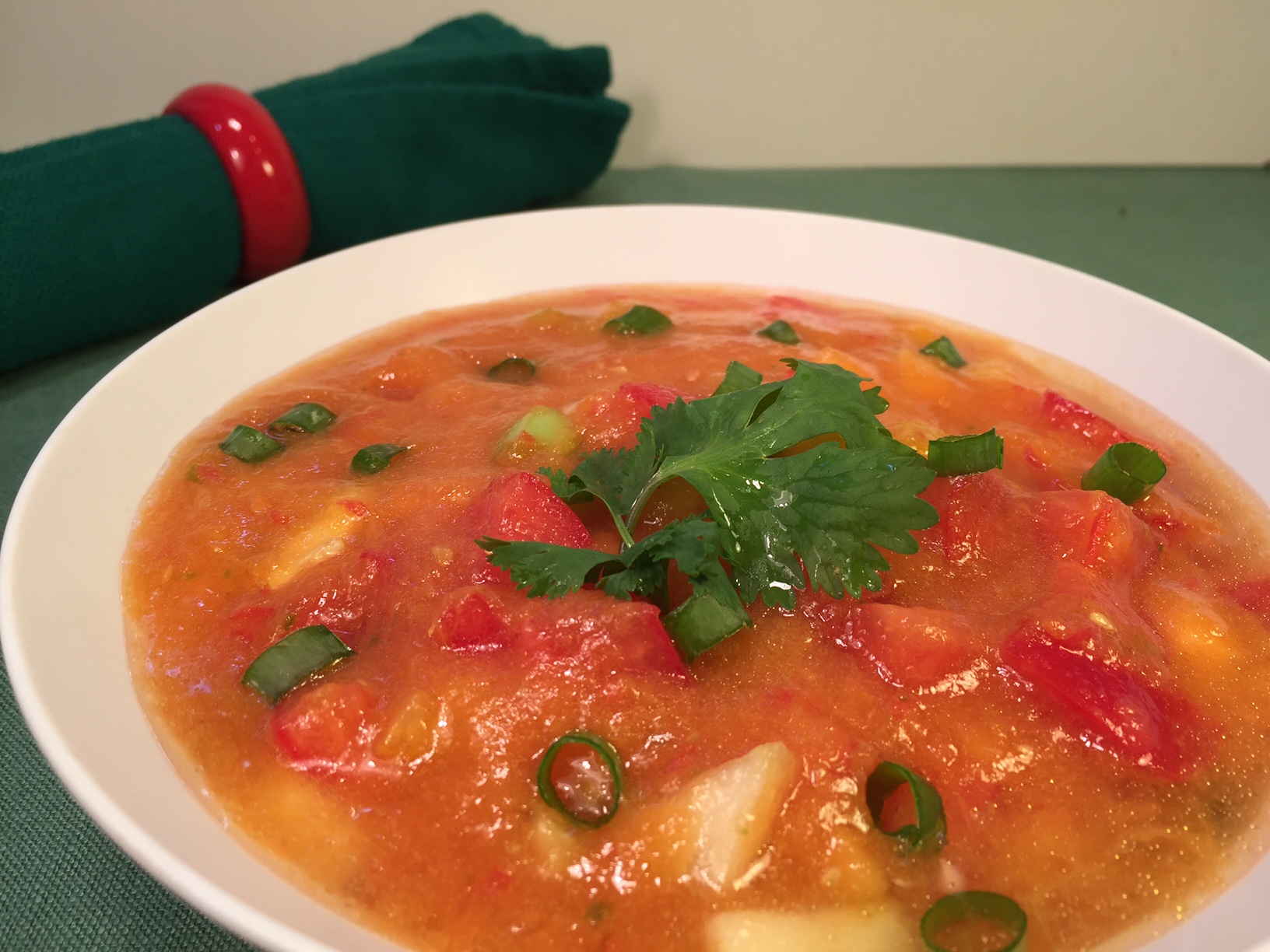
GOLDEN GAZPACHO – Soup With The Midas Touch!

Refreshing GOLDEN GAZPACHO

Refreshing GOLDEN GAZPACHO

In my part of the world, summers are brutal. It’s not unusual for temperatures to rise above 100º F (for you celsius folks, that’s over 38º)! So, what am I making for dinner? Soup!

No, the heat hasn’t addled my brain – I’m talking chilled soup, specifically GOLDEN GAZPACHO. The key is to make it early in the day. This serves two functions: 1) the kitchen hasn’t heated up yet so I can comfortably do my chopping, and 2) for Golden Gazpacho to be at its peak of flavor, it needs to be ice cold.

There’s a lot of wiggle room in this recipe. You can adapt it to suit you preferences. In fact, I once mistakenly bought a papaya instead of the called-for mango. (As I sliced through it, I kept waiting for the giant seed – it never came.) Papaya was wonderful, and a lot easier to cut up.

NOTE: Cilantro is one of the ingredients. A lot of people (including myself) think it tastes like soap. So before adding it to your whole batch, do a taste test with a small portion. I have to divide the soup and add cilantro to half since my husband prefers it, and I hate it. But – I love my husband.

GOLDEN GAZPACHO – makes about 5 cups

  • 3 tomatoes (any color), chopped – you can leave the skin on
  • 1/2 cup vegetable stock (purchased or homemade – VEGETABLE STOCK)
  • 1 T chili pepper (any kind), seeded & chopped finely
  • 1/4 cup fresh lime juice
  • 1/4 tsp turmeric
  • 1/8 tsp salt
  • 1 cup orange juice
  • 1 mango, chopped
  • 1 cup melon (cantaloupe, honeydew), chopped
  • 1 small yellow pepper (or orange or red), chopped
  • 1/2 cucumber, skinned, seeded, & chopped
  • 1 T extra virgin olive oil
  • 1/4 cup scallions, sliced
  • optional: 1/2 T cilantro

In a blender or food processor, purée 1 tomato, vegetable stock, chili, lime juice, turmeric, salt, orange juice, 1/3 cup mango, and 1/3 cup cantaloupe. Pour into large serving bowl and add remaining ingredients. Season to taste with salt and pepper, if desired. Refrigerate at least 4 hours – the longer, the better.

Potato Cheese Soup = A United Family Meal

You know those kids who happily eat (or, at least, TRY) any food that’s put before them? Well, unfortunately, none of them lives in my house. My children have never exactly been culinarily curious.

I suppose I should have insisted like June Cleaver did on Leave It To Beaver when The Beav refused to try his Brussels sprouts. Mom & Dad made him stay at the table until he took a bite. Naturally, he grudgingly sampled one, loved it, and everyone rejoiced in the glow of Brussels sprout bliss.

Often times I’ve felt like a short order cook – making one meal for my husband and me, and one for the kids (sometimes each child even got his own selection). This may sound like a lot of work, but for me it was just simpler to crank out the food so I could enjoy dinner without the wheedling, bribing, threats, and anger.

There were, thankfully, a few meals that satisfied the entire family. It goes without saying that I prepared those frequently.

Potato Cheese Soup is high on the preferred list. Not only is it easy to prepare, but because it’s creamed in a blender (or food processor), you can add in a little spinach, etc., and the kids will never know. (We moms have to be a bit sneaky – it’s for their own good….they’ll thank us later.) Also, you can plop in broccoli or cauliflower – the soup is kind of like a cheese sauce.

As noted, this recipe requires a blender or food processor. I haven’t nagged about owning one or both of these appliances in awhile, so with the after-holiday sales, I’ll suggest these items go on your purchase list, if you don’t already own them. Both are invaluable in the kitchen. I use my food processor and blender nearly everyday.

POTATO CHEESE SOUP – makes  7 – 8 cups

  • 42g (3 T) butter
  • 264g (2 cups) onions, coarsely chopped
  • 1 tsp garlic, minced
  • 917g (2 lbs) russet potatoes, unpeeled and coarsely chopped
  • 82g (1 large) carrot, unpeeled and coarsely chopped
  • 710g (3 cups) vegetable stock, purchased or homemade (recipe:  https://vegcookingforcarnivoresblog.com/2014/04/14/back-to-basics-vegetable-stock/)
  • 1 tsp dried dill
  • 245g (1 cup) milk (I use nonfat)
  • 1 tsp salt
  • ¼ tsp pepper
  • 144g (5 oz) cheese, shredded (I use medium cheddar)

Melt butter in a stockpot. Sauté onions over a medium flame for about 7 minutes, stirring often.

Add in the garlic, potatoes and carrots, and continue to sauté another 10 minutes.

Add in the stock, dill, salt, and pepper. Bring to a boil, then turn down flame to simmer the soup. Cover and cook until the vegetables are tender – test if carrots are easily pierced with a fork.

Remove the lid and let cool about 10 minutes – you don’t want to put boiling liquid in your blender.

Add milk to the pot, then pour into a blender or food processor.  Puree until smooth. (Depending on the size of your blender, you may have to do this in batches and, because of this, a second pot will be needed into which you empty the puréed batches.)

Place shredded cheese in the empty pot.

Pour the pureed sauce on top. Heat to melt the cheese and blend into the soup.

This soup is delicious served with homemade French bread – https://vegcookingforcarnivoresblog.com/2014/05/18/ooo-la-la-les-baguettes-tres-simple/

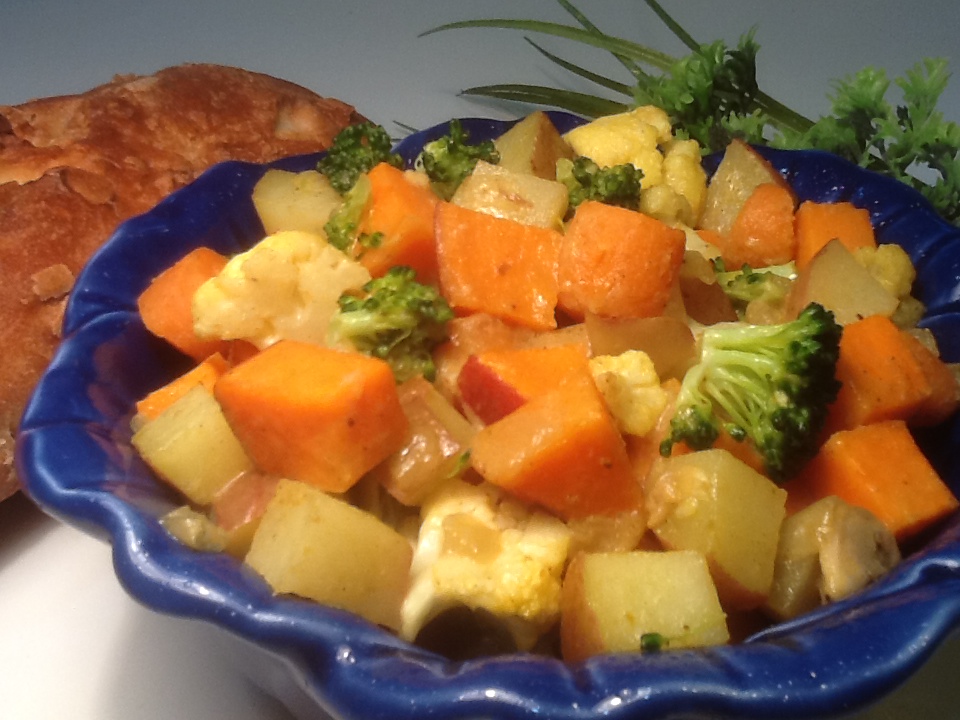
Vegetable Curry Stew – A Winter Warm Up!

Curry Stew

Vegetable Curry Stew

There’s nothing better on a chilly evening than a nice savory stew. If you’re a curry lover, you’ve got to try my Vegetable Curry Stew. The combination of coconut milk, spices, and vegetables is the stuff of which dreams are made.

Besides warming the cockles of your heart (and stomach), this stew has the benefit of being low in calories. Who couldn’t use THAT as we begin our journey down Weight Gain Road. Even though Halloween is behind us, leftover candy certainly isn’t. Coming up are the food related holidays of Thanksgiving, Christmas, Hanukkah, New Year’s Eve, and the parties that go along with them.

You may be wondering how Vegetable Curry Stew could possibly be low in calories when coconut milk is involved. As always, it’s all about portion control. Instead of using canned coconut milk, I buy powdered. That way, I can use less but still get that luscious coconut milk flavor. If your store doesn’t carry powdered, just buy it online. I use Maggi brand, but I expect they’re all good.

Next, you may be wondering if you can just use part of the can and dilute it with water. While I’ve never done it, I see no reason why you can’t. But the reason I don’t is the powdered is so much easier to use, and it takes up less space in the pantry (always a plus.) Also, I don’t have to worry about what to do with the leftover (you know how I hate waste!). I’m not sure how well coconut milk freezes. Of course, you can double the recipe and use up the can that way.

Finally, you may be wondering how I know what you’re wondering. It’s a gift!

NOTE:  Don’t get frightened by the long list of ingredients.  Most of them are spices – all of which a well-stocked kitchen should have. The thing about herbs and spices is that they’re initially expensive.  BUT once you’ve bought them they last a long time.  Don’t believe those people who say you have to throw them out after a year. Buy the spices and cook from scratch – you are going to save money in the long run.

VEGETABLE CURRY STEW – makes 4 to 5 cups

  • 3 T butter
  • 1 cup onions, chopped
  • 2 garlic cloves (about 1½ tsp), minced
  • 1 tsp coriander
  • ½ tsp dried ginger
  • 1 tsp cumin
  • ½ tsp cardamon
  • ½ tsp dried mustard
  • 1/8 tsp ground cloves
  • ½ stick cinnamon
  • 1/8 tsp cayenne pepper
  • ½ tsp tumeric
  • ½ tsp salt
  • 1/3 cup coconut powder (or half can coconut milk)
  • ¾ cup water (eliminate this if you’re using canned coconut milk)
  • 1 cup carrots, chopped
  • 1 T lemon juice (fresh or bottled)
  • 1 cup potatoes, chopped (I use Yukon)
  • 1 cup yam, chopped (I use garnet)
  • 1 cup cauliflower, chopped
  • 2 mushroom, chopped
  • 1 cup broccoli, chopped

WHEW!  That’s a lot of typing. If you’re one of those cooks that likes to have everything prepared before you start cooking, go for it.  But I’m going to give you instructions for the fastest way to prepare this stew. There’s a lot of down time when various ingredients are simmering, so that’s when I prepare the next lot.

Melt the butter in a large pot. As it’s melting, chop the onions and skin the garlic. Add the onions and press the garlic into the pot. Sauté for 10 minutes.

As the onions are cooking (make sure you stir them now and then), assemble your spices, measuring spoons, coconut powder, water, and lemon juice. Chop the carrots.

When the 10 minutes are up, turn off the burner and add the spices. Sauté over a low heat for 2 minutes. Add in the coconut milk, water, carrots, and lemon juice. Bring to a simmer. Cover and let simmer for 10 minutes.

While this is simmering (stir now and then), prepare the potatoes, yam, cauliflower, and mushrooms.

When the 10 minutes are up, add in the chopped potatoes, etc. Cover and simmer 10 minutes.

As this is simmering, prepare the broccoli.

When the 10 minutes are up, add in the broccoli. Simmer 5 minutes.

Serve immediately or reheat later.


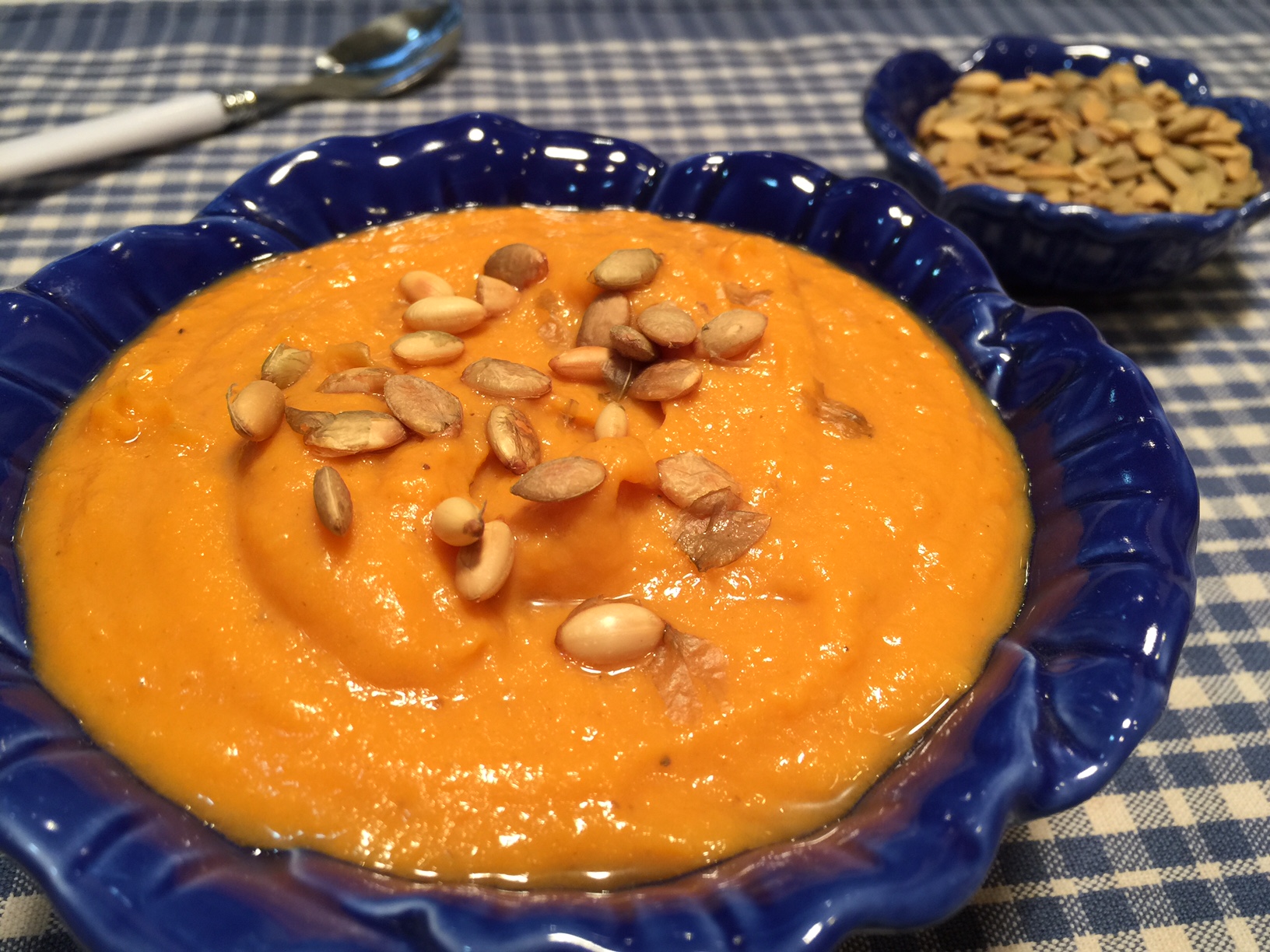
CREAMY SWEET POTATO SOUP – Without The Cream!

CREAMY SWEET POTATO SOUP

CREAMY SWEET POTATO SOUP

Cream soup without the cream? What?  How can this be?

Oh – it be!  Thanks to your handy-dandy blender.

Wait – you say you don’t have a blender?!  As many of you know, I don’t like to throw money away on frivolous things (cheap!). There are many kitchen gadgets that are one trick ponies – you can only use them for one thing (such as a bread maker). I’m not a fan.  BUT, I do believe in stocking your kitchen with tools that will ease the task of cooking, thus making it more likely you WILL actually cook. Items such as a food processor, toaster oven, a wide assortment of pots, and a BLENDER!

Please note, that I put food processor AND blender on the list.  That’s because they are both useful in different ways. The food processor is great for shredding carrots & cheese, chopping tomatoes and onions, kneading dough, finely grinding nuts. The blender uses a funnel action and is great for puréeing soups, pesto, and yogurt shakes. By the way, you can find these items at thrift shops if you’re on a tight budget.

A couple of weeks ago I wrote a blog about eating soup for lunch (click on Slim Down With Vegetable Soup) to help lose those extra pounds one accumulates during the winter months and (let’s be honest) just plain life. I based the idea on that old Campbell’s Soup commercial where the girl wanted to fit into her itsy bitsy bikini so she replaced her calorie laden lunch with soup.

I decided to add another soup to the list:  Creamy Sweet Potato Soup. Which brings us back to the blender. (See how I did that?  I returned us seamlessly to the beginning of the blog.) Did you know if you purée soup in a blender it gets creamy, even if there’s no cream in it? It makes you feel like you’re indulging in something decadent when, in reality, it’s low in calories. Plus, soup fills you up pretty quickly which satisfies you long enough to get you away from the table.

The last time I was in London, I had a wonderful Sweet Potato Soup made with coconut milk and coriander. It was a lovely blend of flavors. I decided to try to duplicate the essence while ditching a lot of the calories.  Also, to make sure it met vegetarian criteria (this is a vegetarian blog, as you know), I used vegetable stock in lieu of the suspected chicken broth.

So I started throwing ingredients together until I came up with a taste I was happy with. (OR, ‘of which I was happy’, for you English majors). A little tip for those of you who like to either create your own recipes or just tweak other peoples’:  write down the ingredients and the amounts you use.  Then make notes about the taste and possible suggestions for future attempts.  You don’t have to write a novel – just a quick, ‘try oregano instead of basil next time’. I’m a firm believer in not reinventing the wheel. When you find something that works (or doesn’t) keep track.  That way you’ll save yourself time in the future AND be able to make it again. No matter how good your memory is, over time one forgets minutia such as ‘was it 1 cup or 1½?’ or ‘did I use garlic SALT or POWDER?’.  Once you write it down, it frees your mind and you don’t have to worry about it again.

As far as the coconut milk goes, you can use either canned or powdered.  Canned is more accessible in my town, but I prefer the powdered so I just order it online. If you use the canned, you’ll need to decrease the amount of vegetable stock since there’s water in it already. By using the powdered, I can play around with how much coconut goes in the soup. Also, I can half the recipe and don’t have to worry about what to do with the unused half. Plus the powder takes up less cupboard space. But, at the end of the day, it doesn’t really matter as far as taste is concerned which you choose.

SWEET POTATO SOUP – makes 10 cups

  • 9 cups sweet potatoes or yams, chopped
  • 1 large onion, coarsely chopped
  • 2 T olive oil
  • 1½ tsp dried cumin
  • 1½ tsp dried coriander
  • 1/3 tsp dried ginger
  • 1/3 cup coconut milk powder (or 1  14 oz can)
  • 4 cups vegetable stock (or 2¼ cups if using canned coconut milk)
  • 1 tsp salt
  • few twists of pepper
  • 1 bay leaf

Heat the olive oil in a very large stockpot and sauté the onions about 5 minutes – until they begin to brown. Add in the cumin, coriander, ginger, bay leaf, salt, and pepper. Stir for another minute to bring out the flavors. Pour in the sweet potatoes, coconut powder, and vegetable stock. If you’d like to make your own stock (which I ALWAYS do), you can find my recipe by clicking on BACK TO BASIC: VEGETABLE STOCK. Bring to a boil, then cover and simmer until the sweet potatoes are tender – about 20-30 minutes.

Let the soup cool down a bit, REMOVE THE BAY LEAF (notice the caps – this is important!), then pour into your blender (in batches, if need be) and purée. Serve either hot or cold.

NOTE:  Toasted pumpkin seeds are a tasty topping – and they’re visually appealing.

If you’re in a hurry (and who isn’t?!), you can make this soup even faster by skipping the sauteing onions part and just throwing everything into the stockpot. I’ve done this many times, and the soup is still excellent.




Slim Down With Vegetable Soup

Vegetable Soup

Vegetable Soup

For those of us in the Northern Hemisphere, the sun is making its clothes-shedding presence known. Spring is melting into summer and bulky sweaters are being replaced by sleeveless tops.  Goodbye bulge hiding parkas; hello bathing suits.

It’s about this time of the year we start to regret not keeping up with that annual New Year’s resolution we make every January 1st. You know the one – to get into better shape by eating healthier and exercising more. Oh, the best laid plans.

Well, it’s never too late!

Years ago there was a Campbell’s Soup commercial showing a young woman whose goal in life was to fit into her itsy bitsy teeny weeny yellow polka dot bikini. She devised a plan to eat Campbell’s Soup for lunch instead of her presumably usual calorie laden meal.  She also had said bikini hanging on her wall for inspiration.  I’ve never forgotten that commercial – not only because they had that fun yellow polka dot bikini song playing throughout, but because the premise made sense.

It’s been proven that it takes about 20 minutes for the brain to figure out that the stomach is full. This is why diet experts always tell us to eat slowly. What’s so great about soup is that because of its high water content it fills us up quickly. Of course, because of it’s high water content, we get hungry again sooner.  But, at least, the soup got us away from the table unscathed.  With a little planning we can have a low calorie snack (such as another bowl of soup, a banana, or some yogurt) mid-afternoon to tide us over until dinner.

Of course, if you have a soup made with cream and/or butter, you’re defeating the purpose. I’ve been making a vegetable soup that’s super easy (just throw everything into the pot) and varies depending on which veggies I have on hand or feel like buying.  Sometimes, when I’m in a decadent mood, I even sprinkle on a little shredded cheese – just for the protein, of course. It’s also a great way to get those daily servings of vegetables – especially for the kids.  For some reason they seem to eat them in soup.

VEGETABLE SOUP – makes about 7 cups

  • 1  28 oz can whole peeled tomatoes, remove stem ends and chop
  • 1½ cups vegetable stock  (for recipe, click on VEGETABLE STOCK)
  • 1 cup onions, chopped
  • 1 cup carrots, sliced
  • 1 zucchini, halved and sliced
  • 3 mushrooms, coarsely chopped
  • 1 stalk celery, diced
  • 3 small white potatoes, chopped
  • ½ tsp dried oregano
  • ½ tsp dried thyme
  • 1 tsp salt
  • optional suggestions:  spinach, quinoa, barley, green beans, cauliflower, kale

Clean and prepare all veggies.  Throw everything into a large pot and bring to a boil.  Cover and turn down heat. Simmer until vegetables are cooked – I always judge by the carrots. EASY!!!

The nice thing about making your own soup (sorry Campbell’s) is that it’s so much cheaper and you can tailor it to suit your taste.  Also it’s a great way to use up those leftover veggies that you just can’t bring yourself to throw out.

Apologies to those of you who now have the itsy bitsy bikini song running in your head!


Back To Basics: Vegetable Stock

Vegetable Stock

While bread may be the staff of life, a good stock is the foundation of a great many vegetarian recipes.  It’s the little black dress of cooking (sorry men – I’m not sure if there’s a male equivalent): every woman should have at least one and you can accessorize it many ways, depending on the occasion.

Yes, it’s true, you can buy vegetable stock in cans and cartons.  In a pinch, that’s a reasonable way to go.  But making your own can save you money (which you should know by now is something I love), AND you can customize it to suit your own taste.  I’ve found the kind you buy are a little heavy handed with the flavor.  Vegetable stock should just add a little flavor to your dish, not overpower it.  Finally, when you make your own, you don’t have to worry about the potential heath concern of BPA in canned foods.

Before going any further, let me point out to those of you who may not know this:  ‘stock’ and ‘broth’ are NOT the same thing.  I used to use those words interchangeably.  Then when I was prepping for my radio cooking show episode on soups, it occurred to me that I should really look those words up so I didn’t give out misinformation.  Low and behold, there was a difference.  A broth takes a stock and goes one step further by seasoning it. Broth would be something you would actually drink, while stock is an ingredient in something such as a soup, casserole, or sauce.

I got this Vegetable Stock recipe from the New Recipes From Moosewood Restaurant cookbook and am quite happy with it as is.  But, of course, you can adjust as you wish.  I ALWAYS double this recipe and freeze it in ½ and 1 cup portions.  By freezing it in the smaller amounts, I can thaw out just what I need.  As you can imagine, I have a LOT of freezer containers.

VEGETABLE STOCK – makes about 8 cups

  • 10 cups water
  • 2 russet potatoes, unpeeled and quartered
  • 2 large carrots, sliced into 2″ pieces (I throw the green stems in, too)
  • 1 large onion, peeled and quartered
  • 1 celery stalk, sliced into 2″ pieces
  • 1 red apple, cored and quartered
  • 12 peppercorns
  • 1 bay leaf

NOTE:  Make sure you wash your vegetables thoroughly – get in all the nooks and crannies!

Put the water into a large stockpot and begin heating it to a boil as you prepare the veggies. Just throw them in as you go.  Once everything is in the pot and it’s at a full boil, cover and lower flame to keep it at a simmer.  Simmer for 1 hour.

I want to stress the importance of this next step so I will use caps:  Strain the stock by pouring it into a colander THAT’S SITTING ON A CONTAINER.  The veggies will stay in the colander while the stock will drain into the container.  You may be wondering why I emphasized this.  I’m embarrassed to admit this, but one time (possibly twice) I was doing ten things at once and when the time came to strain the stock, I put the colander in the sink and emptied my stockpot of Vegetable Stock into it.  I watched in horror as my precious Vegetable Stock rushed down the drain.  I’m sure you must have heard the scream!  Anyone who’s drained a pot of cooked pasta in the sink will probably understand how this happened.

Actually, I found a way to prevent that from ever happening again:  I bought a large stockpot that has a colander insert.  Now I just put the veggies in the colander as it sits in the boiling water.  When it’s done simmering, I lift up the colander and let it sit askew on the pot to drain.

The only problem I have with this recipe is what to do with the cooked veggies.  Currently, I put them in the green waste for composting, but I always wonder if there’s something edible I can do with them.  If anyone has a solution to this dilemma, I’d love to hear your thoughts.


Squash Stew (or, How I Learned The Importance Of Carefully Reading A Recipe)

SQUASH SOUP

SQUASH STEW

You know the old saying –  ‘haste makes waste’?  Well, what with daylight saving time, I was hurrying to make dinner after I looked at the clock and realized it was already 6:00.  I’d planned on making Squash Stew in order to use up some leftover hominy I had from several days ago.  As you know, I hate waste (aka, CHEAP!) so I often plan meals around leftover bits and pieces.  Squash stew is not a complicated recipe and I had everything I needed.  But, as I said, I was in a hurry and when I read ‘sesame seeds’ in the recipe, I went to the fridge (that’s where I keep my nuts and seeds) and pulled out the sunflower seeds.  My brain then made the mental change that even though I knew I was holding sunflower seeds, that was what I needed.  My brain obviously needed rebooting.

What I needed to do with the sesame seeds (in this case ‘sunflower’ seeds) was to toast them with some slivered almonds, and then grind them in the food processor.  As they were toasting,  I was chopping and stirring and blending and trying to get 10 things done at once.  When I went to throw the seeds and almonds in the food processor I realized my error.  BUT, my husband was waiting for dinner.  I was starving.  Time was a-wastin’!  Then I thought of another old saying –  ‘nothing ventured, nothing gained’.   So I carried on with the sunflower seeds thinking how bad could the switch be?  Oh! –  it be bad!  Not SO bad that it was inedible, but – let me put it this way:  I won’t be making that mistake again.  Yeah – nothing was gained from THAT venture.  Besides the taste being a little off, there was an unappealing smell to it.  Which brings me to the last old saying of the day –  ‘live and learn’.

What follows is the actual recipe, which is fabulous!  By the way, if you’re unfamiliar with hominy (I was), it comes in a can and is in the hispanic foods section of my market.  And, remember:  sesame seeds, sesame seeds, SESAME seeds!!!

SQUASH STEW – serves about 4 people, depending on how hungry everyone is

  • 1 ½ cups cubes butternut squash
  • 1 onion, chopped
  • 1 T olive oil
  • 1 clove garlic, pressed
  • ¾ tsp ground cumin
  • 1 tsp dried oregano
  • 1 T chili powder
  • 4 mushrooms, roughly chopped
  • 1 tsp salt
  • 1 ½ cups liquid (water, vegetable stock, or tomato juice from the canned tomatoes)
  • 1 ½ T sesame seeds
  • 1 ½ T slivered or sliced almonds
  • 1 lb canned tomatoes, chopped (I buy the 1lb 12 oz can and save the unused tomatoes for future use)
  • 1 ½ cups cauliflower, cut into ¾” pieces
  • 1 cup hominy
  • ½ cup peas
  • optional:  drained yogurt to dollop on top (Line a sieve with a coffee filter and pour in the yogurt. Let drain ½ hour)

First thing to do is peel the squash.  The easiest way to do this and keep your fingers intact,  is to wash and dry the squash (so it’s clean when you slice it), then microwave it for a total of 3 minutes – you don’t have to pierce the skin.  Half way through the 3 minutes, stop the microwave and turn the squash over so it cooks evenly.  Now it will be really easy to peel.  Slice the neck from the bulb.  The neck is the sweeter part, so just use that for this recipe.  (Butternut squashes are big, so if you want to use the whole thing, double the recipe. )  Slice the skin off with a knife, cut them into ¾” circles, then cut the circles up into ¾” cubes.  IMPORTANT NOTE:  When slicing the squash, cut don’t stack the circles – cut one layer at a time.  The squash is still hard and when you start slicing, the top layer can slip which can cause a nasty cut.  I had read this tip, but forgot about it.  And, indeed, the top layer slipped and I cut into my fingernail.  Fortunately, no blood was drawn – but it could have been bad.  In this case, don’t live and learn.  Learn from me, instead.

In your toaster oven, on the little cookie sheet, toast the sesame seeds and almonds until they’re golden brown.  Keep an eye on them – they brown up suddenly.  Unfortunately, they blacken up soon thereafter. Fair warning!  If you don’t have a toaster oven (which you really should), you can toast them on a skillet (stirring often) or use your regular oven.  Set them aside to cool.

Heat the oil in a very large saucepan or dutch oven,  and sauté onions for a few minutes.  Add in the garlic, cumin, oregano,  and chili powder.  Sauté another couple of minutes.  Add in the squash, mushrooms, salt, and the liquid.  Bring to a boil, lower heat,  cover, and simmer until the squash is softened (about 15-20 minutes).

Grind the toasted sesame seeds and almonds to a powder in your food processor.  (If you don’t have one, start saving up to buy one – they are indispensable!)  You’ll have to chop them as best you can, if you don’t have one.  Add the powder to the saucepan along with the cauliflower, hominy, and tomatoes.  Continue cooking another 10 minutes.  Add in peas and cook until the cauliflower is tender.  Add extra seasoning (salt, chili powder, whatever), if desired.

I like to add a dollop of drained yogurt to each bowlful – not only is it pretty, the yogurt adds a nice tang.