
Ooo La La! Les Baguettes: Tres Simple!!!

French Bread

French Bread

The smell of freshly baked bread is an attention grabber like no other. It’s universal.  At first whiff, people the world over fall into a Zen-like state…. followed immediately by a growling tummy.

Basking in that intoxicating aroma, we imagine the warmth as we break open a piping hot baguette, slowly pulling it apart, and bringing it up to our eagerly awaiting mouth.  We can taste the melting butter as it oozes into the nooks and crannies.  The crunchy outside, the soft insides. They call it the staff of life for a reason.

And, of course, it looks pretty cool when it’s sticking out of your shopping bag.  Note my photo above.

I have to admit, when my kids were growing up, I MAY have gone a little overboard.  Since I was a stay-at-home mom I decided to make as much from scratch as I could. Including bread. Including yogurt. Including pasta. I thought if they were indoctrinated with homemade everything, the taste of preservatives, sugar, and salt laden foods (like store bought cookies, box mac and cheese, and sugary cereals) might not appeal to them.

Yeah, well – it seemed like a good idea.  Unfortunately, I didn’t anticipate the pull of peer pressure.  Not to mention that sugary/salty foods just plain taste good.  After all, that’s what they’re meant to do to keep people eating them.

It was on the job training for me – my mother was not exactly an adventurous cook.  Lots of roasts, burgers, frozen dinners.  She had no culinary words of wisdom to impart to me, her only daughter. So I read cookbooks and just jumped in. There were surprisingly few failures – cooking really isn’t as difficult as one might think – if you follow the instructions!

The first bread I tried making was whole wheat. What with having kids now, I knew that would be the most important since sandwich making was going to be a daily activity for years to come.  It was a bit tricky and I had to constantly revise my recipe.  The problem was, the healthier the bread, the more it tended to fall apart.  Not a good thing! It got better through the years, but it was never like the OroWheat bread I, admittedly, buy now.  In my defense, I hardly eat sandwiches anymore so I keep a loaf frozen….just in case.

Next, I tried my hand at making French bread.  Ah, ha!  (Or should I say – Voilà!) This was a success from the start. It’s quite easy to make and there are very few ingredients.  I did allow myself the luxury of buying a French bread baking pan.  You can see it in the photo below.  It’s a perforated metal, curved double loaf pan.  The curved sides keep the bread in the traditional round shape, and the perforated metal allows for air circulation. It’s not a necessity, though.  Your loaves will still come out delicious just using a cookie sheet.
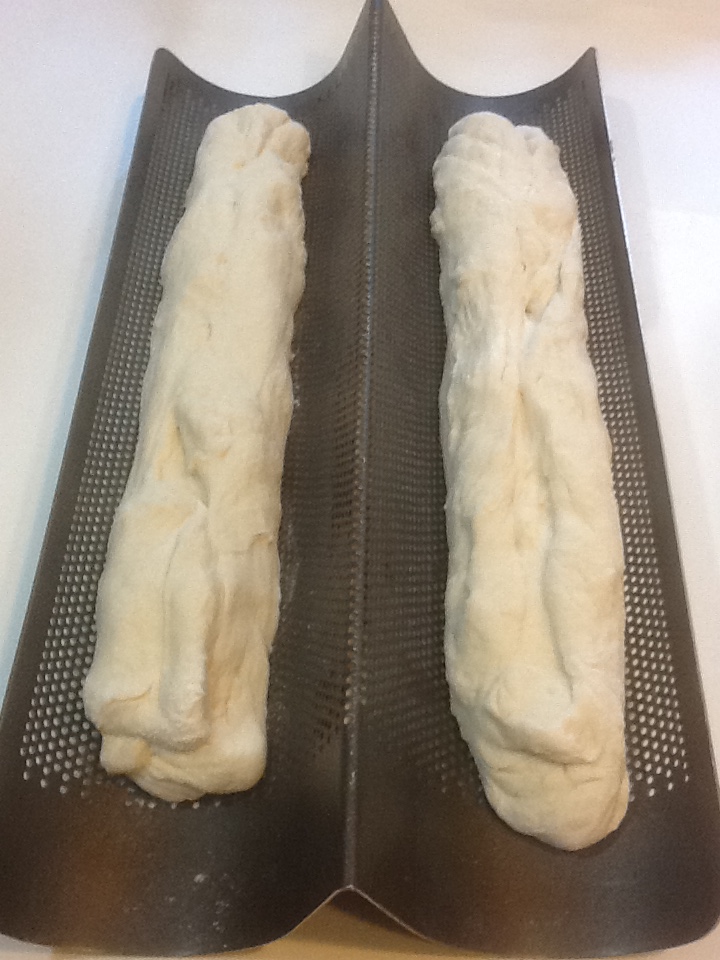
Bread dough rising in a perforated French bread pan

Bread dough rising in a perforated French bread pan

NOTE:  I actually bought two bread pans. Back in the days when I was baking lots of French bread, I would make four loaves at once, then freeze what we didn’t eat.  While freshly baked baguettes are best (unintentional alliteration), they still freeze well. You know me – use that freezer!  If you’re going to the trouble of cooking something, make multiple batches and freeze the extras so you can have homemade food even on days you can’t/don’t want to cook AND you only have to wash the cookware once.

YES, French bread is a yeast dough. NO, it’s not difficult.  I promise!!! And, YES, it takes time because the dough has to rise.

BAGUETTE – makes 2 loaves

  • 2¼ tsp dry active yeast (or 1 packet)
  • 1½ cups water
  • 1 T sugar
  • 2 tsp salt
  • 3½ – 4 cups all-purpose flour
  • ½ tsp cornstarch
  • ¼ cup water (separate from water mentioned above)

The first thing to do is to activate the yeast.  To do this, simply heat the 1½ cups of water to about 100º Fahrenheit (hot tap water will do) and stir in the yeast.  Set it aside to proof – it will begin to foam-up.

Into your food processor put 3 cups of the flour (we’ll add the rest as needed), the sugar, and the salt.  Attach the lid. When the yeast is proofed (it takes about 5 minutes and will be foamy on top), turn on the processor and slowly pour in the yeast water through the feed tube.  Once all the water is in, continue to let the machine run for 30 seconds or so to incorporate the flour.

More than likely you’ll need to add more flour.  What you want is the dough to form a ball. With 3 cups of flour, it’s probably still all over the workbowl.  Add in ½ cup more flour and run machine again.  If it still doesn’t form a ball on it’s own, add more flour 1 tablespoon at a time until it does. Give it some time to run when you add in more flour – it takes a few seconds for the new flour to incorporate.

When the dough ball forms, continue to run the machine for 45 seconds to knead it.

NOTE:  If you don’t have a food processor, you’ll have to do all the above steps in a bowl and knead for 10 minutes by hand.  But, honestly, think about buying  one.  I use mine nearly everyday!  It’s a great time saver.  Plus, I HATE sticky dough on my hands. Letting the food processor run for 45 seconds is so much better than kneading dough by hand for 10 minutes!!!

Take the dough ball out of the food processor and smoosh it down into a greased bowl. Then pick up dough ball, flip it, and smoosh down the other side into the bowl.  This greases the whole ball.  Cover with a tea towel and let rise for about 1 hour.

Punch down the dough. If you’ve never heard this term before, you may be thinking I’ve gone a little crazy. Punching down dough simply means taking your fist and punching the risen dough to deflate it. This is my favorite part of bread making. But mind if you’re having a bad day – DON’T punch the tar out of the dough. (He’s not the one who wouldn’t let you in when you forgot you wanted to turn left and were in the wrong lane.) Just a quick love tap will do. Then divide the dough in half.  Take each half and stretch it to the length of baguette you want. Obviously, the longer the bread, the thinner the loaf.  Whichever way you like it is fine.

Lay each stretched out loaf on a groove of your French bread pan or a cookie sheet that been greased and sprinkled with cornmeal. Cover the loaves and let rise for 30 minutes.

In a small saucepan, heat together the ¼ cup water and cornstarch over a low/medium heat.  Stir constantly until the liquid becomes less murky.  This will happen at the boiling point.  Remove from heat.

Preheat oven to 425º.

When dough has risen and oven is preheated, make 2 or 3 diagonal slashes in the raw loaves with a sharp knife or pair of scissors. Brush with cornstarch glaze and bake for 10 minutes.  Brush with glaze again, and continue to bake an additional 15 minutes.  Remove from pan and serve!

Added bonus:  The aroma of freshly baked bread will linger in your house for awhile, reminding your family just how hard you work for them!



Peanut Butter Buns – OR, Two Salts Do Not A Sugar Make

Djash - Peanut Butter Roll

Djash – Peanut Butter Bun

You may or may not be aware, but we Armenians love our food.  I mean we LOVE our food. When I was a kid, family gatherings were centered around the preparing of the feast, the eating of the feast, the cleaning up after the feast, a brief interlude, and then the eating of the leftover feast. Yeah – we like our food.

My dad always loved telling us about how his mother made this fabulous after-school snack called ‘djash’ (pronounced ‘josh’).  It was a rolled bread filled with peanut butter.  With five hungry children in the house, she used to hide it – hoping to dole it out bit by bit.  But hungry children can be very resourceful and they always found it.  This wasn’t a food my grandmother made for holidays – rather it was an everyday kind of thing.  Something to tide her offspring over between the time they came home from school and dinner.

As far as I knew, djash was just another Armenian food that my family ate, along with shish kabab, dolma, madzoon, lahmajoon, etc.  When people familiar with Armenian foods asked which dishes we ate, I would rattle off a variety of foods.  They nodded knowingly until I got to djash – they’d never heard of it.  I didn’t really think twice about that, except even Armenians didn’t know what it was.  My cousin Sue and I were talking about this (she’d experienced the same thing), and she found out why:  ‘djash’ isn’t a specific food – it means ‘lunch’ or ‘little dinner’.  So when my grandmother made djash, she really meant ‘snack’ – it just so happened the snack was a peanut butter bun.  Now I know why I could never find it in any of the tons of Armenian cookbooks I own.

Years ago my dad had me type up (on a real typewriter – that’s how long ago this was) his mother’s djash recipe.  This was years before I learned to cook anything, let alone a yeast bread, so I didn’t see anything amiss with the recipe.  But recently I made djash and, while it was okay, it seemed like it was missing something.  Then I realized it tasted like it needed sugar.  I went back to the original recipe and there it was – the problem.  Salt was listed twice on the ingredients list, in different amounts.  More than likely, I just figured this was a mistake and eliminated one of the salts.  Now that I’m a seasoned cook (I say modestly), I fixed the problem by reinstating the sugar.

If this is your first time making a yeast roll, fear not – I’ll walk you through it.

DJASH (PEANUT BUTTER BUNS) – makes 12 buns

  • ½ T yeast
  • ¾ cup water, approximately 100ºF
  • 3 cups all-purpose flour
  • 8 T butter, cut up and softened (NOTE: more butter is used further down the ingredients list for the filling)
  • 1 egg
  • 1 tsp salt
  • 2 T sugar
  • ½ lb peanut butter (I used the kind you grind in market yourself, made only with peanuts)
  • 2 T butter, softened
  • egg wash (1 egg and 1 T water beaten together)

NOTE:  If you want a sweeter peanut butter filling, you might want to use a brand like Skippy.  The grind-it-yourself kind has no salt, sugar, or oil added.

Stir the yeast into the water and let proof as you prepare the other ingredients.  Into the food processor put the flour, 8 T butter, egg, salt, and sugar.  Pulse several times.  Once the yeast water is proofed (foamy), turn on the food processor and pour in the yeast gradually through the feed tube.  Soon a dough ball will form.  Let the machine knead the dough for 45 seconds.

Smoosh the dough ball into a greased bowl, then flip it so the top is now on bottom.  (That way the ball is completely greased).  Cover and let rise for 1 hour.  In a small bowl, stir together the peanut butter and 2 T butter. Don’t melt the butter – it will make the filling too runny.

Punch down the dough and divide into 12 balls.  One by one, roll each ball to a 4″-5″ circle on a well floured board.  Spread a rounded tablespoonful of peanut butter over the circle to ½” from the edge.

djash roll up bigger

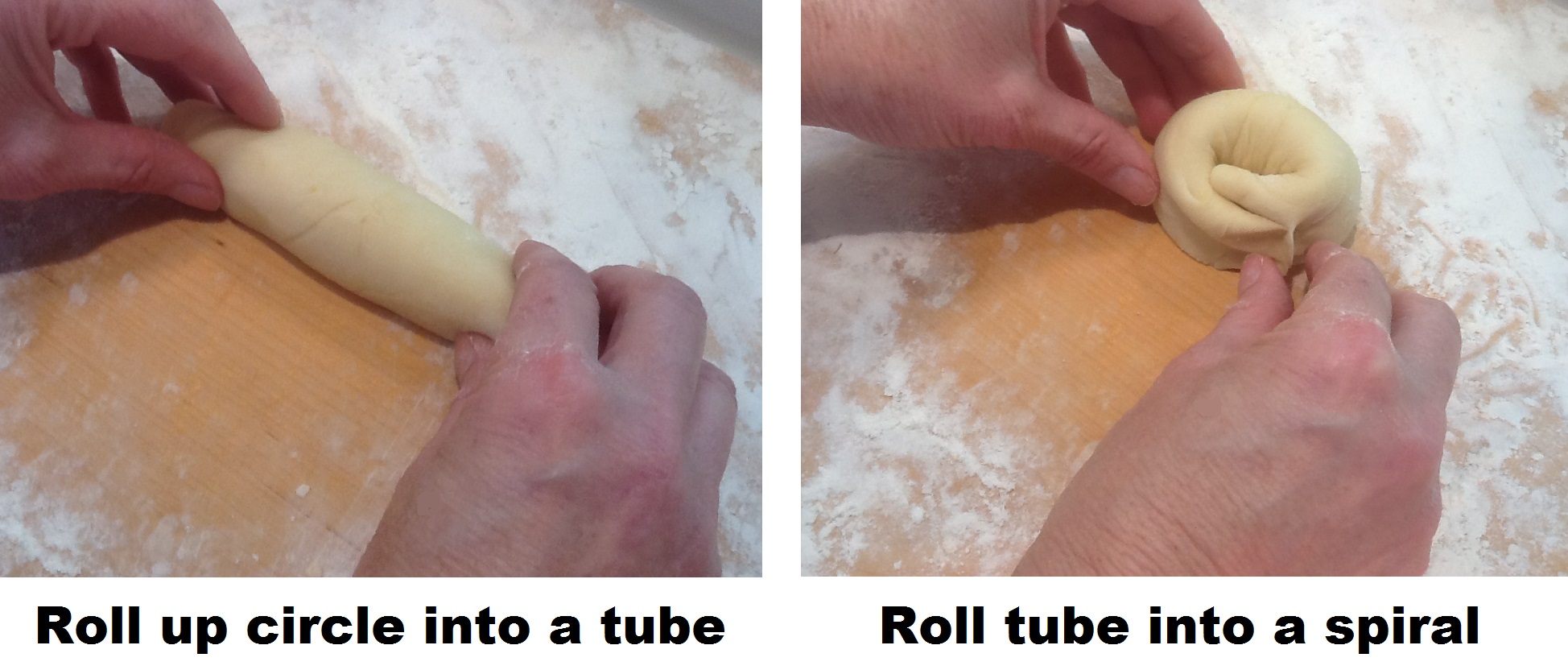
Roll up the circle, like a cigar.  Then roll up this tube sideways into a spiral circle.  Pinch the end into the roll.  After rolling each one, place it on a greased cookie sheet.  Cover them and let rise for ½ an hour.

Preheat oven to 400º F.

Press down each risen roll to ½” thick.  Paint them with the egg wash.  When the oven is heated, place the cookie sheet on the middle rack, then IMMEDIATELY LOWER TEMPERATURE TO 350º F.  Bake for 20 minutes, until lightly golden brown. Remove rolls to a wire rack.  They’re ready to eat hot out of the oven.

One final note from my husband – they would probably taste really good topped with a chocolate frosting.  But, of course, what wouldn’t?!


Beer Bread – No Need To Knead

BEER BREAD

BEER BREAD

Home made bread is one of those things that everyone loves to eat, but most people shy away from making.  Well, have I got a bread for you:  BEER BREAD!   It’s only got 3 ingredients and – like my extremely clever title promises – no need to knead!

Who doesn’t stop in their tracks when they get a whiff of bread baking in the oven?  This is inevitably followed with an audible ‘aaaahhhhh!’  Add in the aroma of beer and people will be lining up for a slice.

This is a super fast and easy bread to make.  For those of you who like to ‘watch’ recipes rather than read them, you can click on: BEER BREAD and watch my how-to video.  (I like the way my hair turned out in that video, btw!)

One of the odd things about this bread is that even if you don’t like to drink beer, you may still enjoy eating Beer Bread.  When I started making this bread, I couldn’t stand the taste of beer (although, oddly enough, I liked the aroma), but I really liked the bread.  Over the years, I’ve grown to like drinking a pale beer now and again – especially on a hot day.

You’ll notice that the recipe calls for self-rising flour.  Make sure you don’t use anything else.  Otherwise your bread won’t rise.  This is one of those specialty flours I keep on hand, stored in the freezer.  (Did you know freezing flour prevents bugs?  I store all my flours in the freezer.)  As far as I know, the smallest size bag of self-rising flour you can buy is 5 lbs. That’s a lot of flour, especially when all you need is 3 cups.  Just suck it up and buy the bag – you’ll eventually use it up.  Once the self-rising flour is awaiting use in the freezer, you can make Beer Bread at the spur of the moment (as long as you have beer on hand….which is a given in my house).  It only takes a few minutes to get it into the oven.

BEER BREAD

  • 3 cups (453g)  self-rising flour
  • 3 T (30g) sugar
  • 1 bottle beer, room temperature and sealed

Preheat oven to 375ºF.

With a spoon, mix the flour and sugar together in a bowl.  Open the beer and pour into the flour all at once.  Immediately begin incorporating the beer into the flour with the spoon. Pour the batter into a greased loaf pan.  Bake for 45 minutes – until golden brown on top.

Take the loaf from oven and let sit a few minutes. Then run a knife around the sides and remove the Beer Bread to a wire rack to cool.

A word of caution:  tempting as it may be to slice into the hot loaf – restrain yourself! Cutting into a hot loaf of bread causes it to fall apart.  And ladies, keep your husband away from it – the aroma of hot bread combined with beer draws them like a magnet.

Say, “CHEEEZE” Biscuits!

photo (30)

Okay, I admit it – a corny title, for sure. But these CHEESE BISCUITS will definitely make you smile. Served hot out of the oven, they have a nice crunch on the outside and are tender on the inside. And if you can manage to snag a few for leftovers, they are almost as good the next day – simply heat them in the toaster oven. What’s that you say? You don’t have a toaster oven? Well, you really should! Besides the obvious (making toast), they’re perfect for heating small amounts of food. Why heat up that large oven for a little job? It’s much cheaper to use a toaster oven. I use mine nearly everyday!

But I digress.  (I’ve mentioned before:  my mind tends to wander.)  You simply must try my CHEESE BISCUIT recipe!  The task may seem a little daunting to those of you who have never made biscuits from scratch – but I guarantee it’s easier than you think!  (Would I steer you wrong?  NOOOO!)  What you have to know is biscuits are a quick bread.  A quick bread is a bread that uses something OTHER than yeast as a leavening agent.  Quick breads can turn tough if you overwork the dough.  What does that mean?  DON’T WORK SO HARD!  Less is more where quick breads are concerned.

CHEESE BISCUITS – makes 8 or 9 biscuits, depending on how big you make them

  • ½ cup plain yogurt, drained (line a sieve with a coffee filter and pour in the yogurt – let drain at least ½ hour)
  • 1 egg
  • ¼ cup milk (I use nonfat)
  • ½ cup cheese, shredded (I use a combination of medium cheddar and asiago)
  • 1 ½ cups flour (I use organic all-purpose)
  • 1 tsp cream of tartar (it’s in the spice section in a jar – not the sauce you put on fish)
  • ½ tsp baking powder
  • ½ tsp baking soda
  • ½ tsp salt
  • 5 T butter, cold
  • egg wash (1 egg beaten with 1 T water) (not the same egg listed above)

NOTE:  Notice you need the yogurt drained – so you have to plan ahead.   I use homemade plain nonfat yogurt in my recipe.  If you’d rather use sour cream, then use only 4 T of butter (½ cup).

ADDITIONAL NOTE:  If you’d like to see my video for how to make yogurt go to: https://www.youtube.com/watch?v=dyIwAixwiUg%5B/

If you have a food processor, put the flour, cream of tartar, baking powder, baking soda, salt, and butter (cut up in several pieces) in the work bowl.  Pulse it several times until the butter is broken up into very small bits.  If you don’t have a food processor (Sigh!  – you really should have one of these, too) put these same ingredients in a bowl and cut the butter into the flour mixture by using 2 knives and cross-cutting until the butter is pea sized.

In a medium bowl beat the egg.  Mix in the yogurt, milk, and cheeses.  Pour the dry ingredients into the wet and gently begin incorporating the two together with a large spoon.  Once most of the flour is mixed in, smash down the dough with your fists into the bowl.  Then fold the dough in half onto itself.  Turn the bowl a quarter turn.   Smash  and fold.  Repeat one more time.  That’s 3 times total – that’s all you ‘knead’ to do.  (Thank you, I’ll be here all week!)

Preheat the oven to 425° Fahrenheit.   Spoon the dough onto a greased cookie sheet (unless you’re using non-stick).  Depending on how big you want them, you should get 8 or 9 (I make 8).  Kind of shape them with the spoon so they’re rounded.  (Of course, you could make cute shapes, if you like – hearts, perhaps?)  Dip a pastry brush into the egg wash and paint the tops of the biscuits.  I like to sprinkle some extra asiago cheese on top – it’s pretty and adds a little extra cheesy flavor.

Bake for 12 – 14 minutes, until the tops are golden brown.

These biscuits make a wonderful addition to so many meals – kind of the cherry on top. Needless to say, they’re NOT low calorie.  But they ARE yummy!  So plan a walk after dinner and enjoy the happy memory of that CHEESE BISCUIT while you enjoy the fresh air!